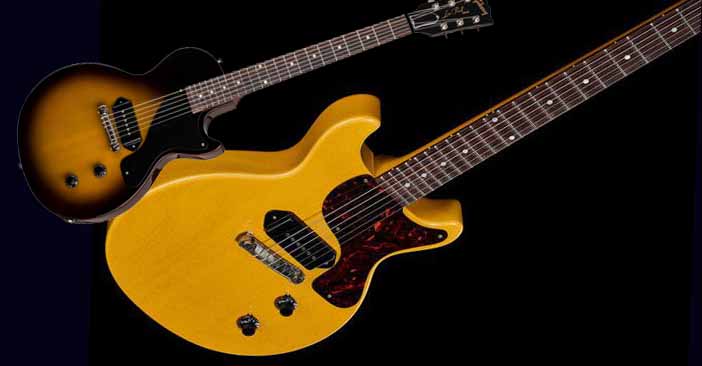
Stripped down, primal, with P-90 snarl and an unfussy aesthetic, there is something so ineffably cool about the Junior... 70 years young, it's one of guitar's hardest-working six-strings.
It couldn’t be any simpler – yet, in truth, it couldn’t be any better. The Les Paul Junior, which was launched in the same year as Fender’s Stratocaster, was in some ways the antithesis of Fender’s svelte three-pickup rocketship.
Made for lowly students, not cutting-edge professional artists, it had but a single pickup in the old-fashioned ‘dog-ear’ shape, while its slab body was functional, rather than futuristic, and its glued-in neck evoked an earlier era of lutherie. Yet, somehow, it always was more than the sparse sum of its parts.
In the right hands, its simplicity became a kind of purity – putting so little between the player and nuanced self-expression. Its surprisingly punchy pickup was well suited to the burgeoning age of rock ’n’ roll, too, with enough clout to make a Tweed amp weep and wail when you turned up the wick.
Even its modest price meant that musicians on the way up, such as Mountain’s Leslie West, could afford it – and that means that when they began to define the sound of rock, they did so with Gibson’s most basic and yet most enduringly capable electric.
“That’s golden-era McCarty. When the original Les Paul model launched in 1952, there was always a plan to also bring about the Les Paul Custom, the fancier model, which debuted in 1954 – along with the Les Paul Junior.
“But with the [launch of the] Les Paul they didn’t really have that, initially. So they started building that structure in 1954 with the introduction of the Custom at the top, the Les Paul regular – as they would call it – and then the Les Paul Junior in 1954. And then the next year they launched the Special to fit in between.” (Read the full article on Guitar World)