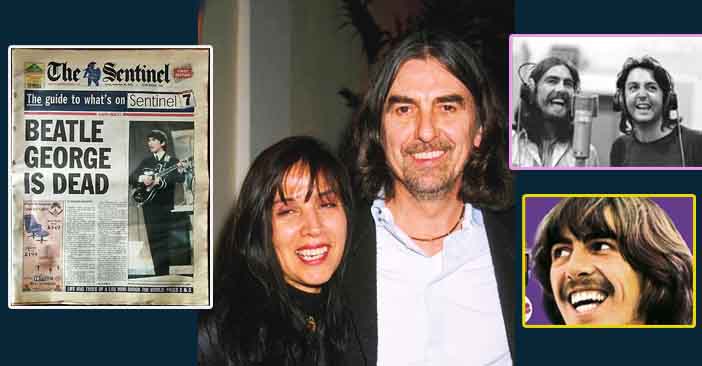
George died on 29 November 2001 (aged 58) Los Angeles, California, US
George Harrison was spiritual his whole life, not just after working closely with his friend Ravi Shankar.(Cheatsheet - I, Me. Mine)

While he was still in The Beatles, George wrote “The Art of Dying” in 1966. It’s about George’s ultimate goal. The ex-Beatle wanted to scrub away all the loose ends in his life and to leave his body peacefully. He didn’t want his soul reincarnated and forced to walk the Earth to perform the tasks he’d left behind.
“Everybody is worried about dying, but the cause of death (which most can’t figure out unless they are diseased) is birth, so if you don’t want to die you don’t get born!” George wrote. “So the ‘art of dying’ is when somebody can consciously leave the body at death, as opposed to falling down dying without knowing what’s going on. The Yogi who does that (Maha-samadhi) doesn’t have to reincarnate again.”In his 1980 memoir, I Me Mine, George explained what influenced him to write “The Art of Dying.”
George explained, “Every action has an equal and opposite reaction,” which is called Karma. “And the only way you escape the chain of Karma, going round and round again, is if you get the seed and you roast it so it can’t germinate (or fry the egg),” he wrote.
“We have to first of all not create more Karma – that is, more actions and reactions – like throwing a pebble into a clear lake, the ripples keep on going. Every thought, word, action or deed that we have is like sending a ripple out across the Universe and it does eventually come back. Whatever you do, it comes right back on you.”
George explained you don’t want to create significant reactions (like being in The Beatles) because “everything comes bouncing back and ties you up forever, or for as long as it takes to untie it.” Those reactions could be what ties you to the Earth for eternity.
George said if you don’t undo all the knots in your life your soul will be force into reincarnation “So in ‘Karma’ we try to burn it out (fulfil desires) and that finally is only possible when we have reached a very advanced spiritual level. The ‘Saviour’ – the ‘Sat-Guru’ – comes at that point in time, and He takes on your remaining Karma.
Run of the Mill’ was one of the first songs written about the Beatles by a Beatle. George Harrison wrote it shortly after the band’s disastrous ‘Get Back’ sessions in 1969, detailing the group’s falling apart.
Specifically, Apple Records was in shambles, John Lennon was pretty much finished with the band and Paul McCartney was becoming Mr. Bossypants. Following the group’s break-up, the band’s members weren’t shy about voicing their disdain for one another either. Not only did they trade insults in interviews, after all, all anybody wanted to talk about was the Fab Four anyway, but the bandmates also used songs to shoot barbs at one another. Paul McCartney famously took aim at John Lennon’s sanctimonious virtue signalling on ‘Too Many People’ on his solo album Ram. In turn, that song led to John Lennon writing the viciously cruel ‘How Do You Sleep?’, a pointed track that came hurtling across the airwaves straight back at McCartney.
It was around the time that Harrison had decided he’d “had enough” and quit The Beatles for a short period of time as all the bad blood had got too much for him. It was during this time that he realised that being in a band would no longer suit his purpose and, if he wanted to get his spiritual message out there, he would need his own platform. All Things Must Pass the magnificent solo LP would be that moment.