I love this photo. There’s something about that whole period that is really so touching for me. I’m at the Newport Folk Festival, which started back in the 50s as an offshoot of the jazz festival, and I’m sitting with Bob Dylan. Bob was about to go on the little folk stage where Joan Baez had first introduced him a couple of years earlier.
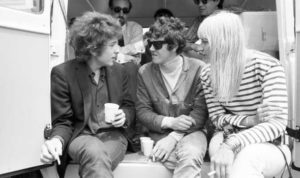
We had been looking at harmonicas as we were both really into them.
In 1965, Bob and I were linked so tightly that they were calling me “the British Bob Dylan”, but in actual fact it was Woody Guthrie who used to sling harmonicas around his neck and Guthrie was a big influence on both Bob and me in those early days.
That comparison with Bob Dylan was so wrong. It was Woody Guthrie I was emulating and it was Woody Guthrie that Bob was also emulating with the cap and the harmonica harness.
I saw an early guitar of Dylan’s in Paris recently and it has Woody’s words scratched on the back.
I used to have a sign on my guitar that said “This machine kills the fascists”, which was from Woody’s guitar sign that said “This machine kills fascists” because he was singing freedom songs back in the 1940s.
The friendship with Bob goes back to a singer called Buffy Sainte-Marie, who was playing up in Newcastle at the American Folk Festival. I met Buffy and Buffy introduced me to Joan Baez. Joanie said, ‘You’ve got to come down to London.

Bob’s arriving in May!’ So in May, I went down and there was me, Joan Baez and Bob Dylan in a hotel room. There was actually a film showing this called Don’t Look Back.
We were so close then because we came from the same background.
Once Dylan told: "You're born with, you know, the wrong name, the wrong parents," said Dylan in 2004, according to Classic Rock. "I mean, that happens. You call yourself what you want to call yourself."
Born Robert Allen Zimmerman in Wyoming in 1941, it purportedly wasn't just his name that Bob Dylan changed. According to Rolling Stone, he went through a period during the mid-60s where much of what he said had the faint whiff of fabrication about it. On a plane trip from Nebraska to Colorado he told the New York Times journalist Robert Shelton that he'd kicked a "$25 a day habit" and turned tricks when he first moved to the Big Apple two months before he switched to the Greenwich Village. And in earlier interviews he liked to claim he worked for six years on-and-off as a clean-up boy for a travelling carnival.
In a 1984 Rolling Stone interview, Dylan said, "I never got hooked on any drug." Regarding working as a prostitute, Rolling Stone believe the story is "complete fiction", and other experts have cast doubt on Dylan's ability to get his own backstory correct, even in his 2004 autobiography Chronicles: Volume One. "I enjoy Chronicles as a work of literature, but it has as much basis in reality as [Dylan's 2003 film] Masked And Anonymous, and why shouldn't it?" Dylan biographer Clinton Helyin said in 2011 (via Rolling Stone). "He's not the first guy to write a biography that's a pack of lies."