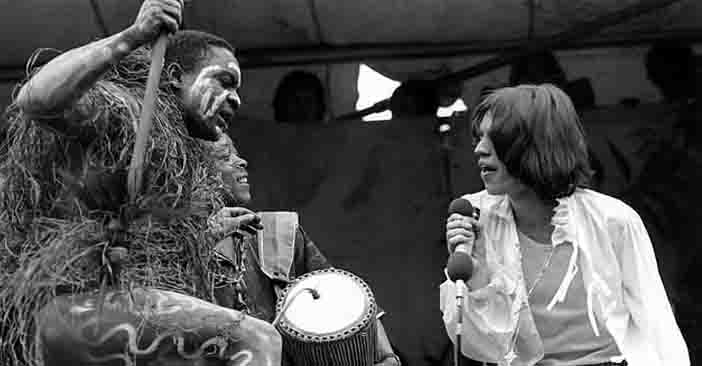
For many artist Music had caused violence before — Elvis Presley and Bill Haley between them having left many a wrecked theatre in the mid-Fifties — but that had been sheer animal spirits.
And at the Altamont festival, so the story goes, those dark forces caused an audience member to be knifed to death in front of the Stones as they callously performed their anthem to Lucifer.
Looking at those wrinkly septuagenarian national treasures today, it’s hard to credit the fear and revulsion they generated half a century ago.
Mick Jagger, in particular, was viewed as a loose-lipped antichrist, single-handedly responsible for turning the nation’s gullible pop fans on to drugs (a total misconception as the social-climbing Mick was always more interested in getting to know aristocrats than getting high.)
The Stones had always been happy to be considered devilish in a cosmetic way, to stimulate record sales.
Their 1967 album in response to the Beatles’ Sgt. Pepper masterpiece bore the brazen title Their Satanic Majesties Request, but turned out to be less hellish inferno than damp squib.
Jagger had actually flirted with black magic as an extension of his hippyish interest in witches and spells, but quickly gave it up in terror and was careful to wear a large crucifix around his neck for months afterwards to ward off the Evil Eye.
The release of The Rolling Stones’ new album Beggars Banquet was celebrated on 12/5/1968 in London with a food fight with custard pies. The original cover for the LP was in the form of a plain white invitation, but was later changed.
Stones putting out three special releases a remastered and repackaged “Beggars Banquet” vinyl reissue; a restored version of “Sympathy for the Devil” expanded reissue of the legendary “Rock and Roll Circus” video and album.
ABKCO Records will release a 50th anniversary edition of The Rolling Stones‘ Beggars Banquet album in November.
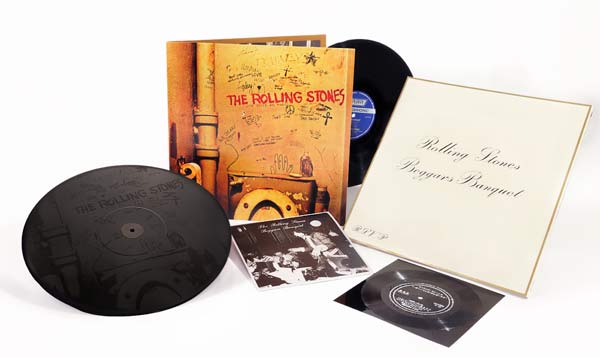
Last upgraded in 2002, the iconic album has been transferred from the original stereo tape to direct stream digital and remastered by mastering master Bob Ludwig. This is an album that should never sound too clean, and the twin engines of this album — Richards’ acoustic guitar and Charlie Watts’ drums — are made brighter .