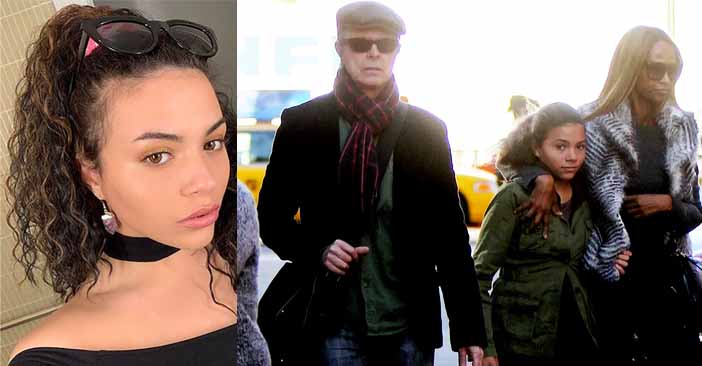
David Bowie’s daughter is clarifying her statements from earlier this month after claiming she was forced to go to a treatment centre when she was younger after her father was diagnosed with liver cancer.
Alexandria “Lexi” Zahra Jones — the daughter of the late singer and supermodel Iman — shared a statement on Instagram to explain that her previous post was meant to help other people who have experienced wilderness treatment programs and battled drug addiction and mental health issues.
“I’ve seen a lot of interpretations of what I shared and I want to clarify something important,” Jones, 25, began. “My story was never meant to place blame on my parents. I love my parents deeply and I don’t hold resentment toward them.” "They were trying to help a child who was struggling in ways none of us fully understood at the time. I never shared this to create a narrative of family conflict,” she wrote.
Forcing her to be away from her father as he lost his battle with cancer. (the Dailymail)
Alexandria 'Lexi' Jones, 25, shared a video on Instagram on Thursday, explaining how her family had taken the decision for her to go to a treatment facility amid her battle with depression and an eating disorder.
When her father was diagnosed with liver cancer in 2014, Lexi said she hit 'breaking point' and turned to drink and drugs to cope. The music legend died in January 2016 aged 69, just two days after he released his final album Blackstar.
Lexi, whose mother is supermodel Iman, 70, described how she was just 14 when two men 'well over six feet tall' came to take her to a treatment facility.
She also recalled her father writing her a heartfelt letter when revealing the decision to send her to the facility, which read: 'I'm sorry we have to do this.'
Looking back on her childhood she said: 'Adults would talk to me differently than they would talk to other kids. Some were not interested in me as a person at all, and only as a proximity to something else.'
Visualizza questo post su Instagram
She added that she felt like she 'existed as an idea' rather than a real person, with constant projections and expectations from others.
She continued: 'Something hit me pretty young before I was around ten. I started seeing a therapist because my teachers noticed something was off, and so did my parents. That was around the time I had my first anxiety attack.
'I started to feel depressed. I was failing school. I had learning disabilities, that made everything feel harder, and I hated the way I looked. I developed bulimia when I was 12. I started self-harming when I was eleven.
'I felt stupid, incompetent, unworthy, useless, unloveable, and having successful parents only made it worse. It felt like I would never live up to them. I couldn't understand how I came from people that were thriving in every single direction while I was failing at everything.'
Following her father's diagnosis and turning to drink and drugs to cope, she said: 'Everyone around me was experimenting. But for me, it wasn't about fun. I wasn't experimenting, I was escaping.
'When the party ended for everybody else, I kept going, and I drank and got high alone. I became someone who lashed out. I was cruel to people who didn't treat me the way I wanted to be treated. I was begging to be respected by becoming something people feared, or at least noticed.'
Eventually, she said, an intervention occurred that was both unexpected and deeply traumatising.
She said: 'My dad read a letter he had written. I don't really remember what it said, but I do remember the last line and it said, "I'm sorry we have to do this".
'Then two men came through the door, and they were both well over six feet tall. They told me I could do this the easy way or the hard way. I chose the hard way. I resisted. I screamed. I held onto the table leg.
'They grabbed me, they put their hands on me, they pulled me away from everything I knew and I was screaming bloody murder. I was screaming for someone to help me, but no one did...
'I felt stripped of any right to stay in my own life. They got me back into a black SUV and shoved me inside. By the time the door shut, my parents were already gone. I was alone. I was in a car with two strange men that wouldn't tell me where we were going and I just sat there completely horrified and silent.'
Lexi said she spent 91 days at a 'wilderness therapy' programme living outdoors in winter conditions with no privacy, showering once a week, and being forced to count out loud every time she used a makeshift bathroom so staff could monitor her.
Wilderness therapy, also known as outdoor behavioural healthcare, is a highly controversial style of mental health treatment developed in the US for adolescents and young adults.