When the idea for a live album was first brought up, producer George Martin wanted to record the band’s Feb. 16, 1964, performance at New York's Carnegie Hall. (UCR)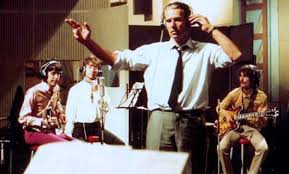
A dispute with the American Federation of Musicians made such an undertaking impossible, so Martin and the band turned their attention toward a different date on the calendar: the Beatles' first performance at the iconic Hollywood Bowl in Los Angeles.
On Aug. 23, 1964, the Beatles played a 12-song set in front of nearly 19,000 ravenous fans. The tape was rolling and the show was good - perhaps too good. The crowd was so enraptured by the Beatles' performance that the recordings were virtually useless, as screaming drowned out the music.
Producer Chris Thomas, now 71, recalls: “I came back at the beginning of September. There was a little handwritten note from George Martin on my desk saying ‘I hope you had a nice holiday, I am off on mine now. Make yourself available to The Beatles. Neil and Mal know you’re coming down." -
“We recorded it on three-track tape, which was standard U.S. format then,” Martin later recalled. “You would record the band in stereo on two tracks and keep the voice separated on the third so that you could bring it up or down in the mix. But at the Hollywood Bowl, they didn’t use three-track in quite the right way. … The recording seemed to concentrate more on the wild screaming of 18,700 kids than on the Beatles onstage.”
Seeing how Phil Spector had assembled the infamously difficult final LP, Capitol approached the producer and asked him to work his magic on the Hollywood Bowl tapes. Regardless of whether Spector thought the material unsalvageable, or the label was simply disappointed with what he turned in, nothing came of his work on the project.
In 1977, Martin received a call from Bhaskar Menon, president of Capitol Records, asking him to listen to the tapes again.
“My immediate reaction was, as far as I could remember, the original tapes had a rotten sound. So I said to Bhaskar, ‘I don’t think you’ve got anything here at all,’” the producer later recalled. “But when I listened to the Hollywood Bowl tapes, I was amazed at the rawness and vitality of the Beatles’ singing. So I told Bhaskar that I’d see if I could bring the tapes into line with today’s recordings.”
Martin recruited engineer Geoff Emerick and the two men began the arduous process of trying the salvage the best of what the tapes had to offer. The duo had 22 songs to work with across the multiple Hollywood Bowl shows. In the end, only 13 tracks would be deemed worthy of inclusion, as others were “obliterated by the screams.”
“The fact that they were the only live recordings of the Beatles in existence, if you discount inferior bootlegs, did not impress me,” Martin later admitted. “What did impress me, however, was the electric atmosphere and raw energy that came over.”
On 4 January 1970 -The Beatles made the last recording session as a group
Although there were two further recording sessions for the Let It Be album involving just one member of The Beatles, this was their last time recording as a group – albeit without John Lennon.
Having completed ‘I Me Mine’ the previous day, The Beatles turned their attentions to Paul McCartney’s song ‘Let It Be’.
Let It Be was made before Abbey Road. It was made at a time when the first visible rifts were appearing between the Beatles. They were not happy days for the boys, and the result was not their best record. John was insistent that it should be a “live” album, and would not let me do any editing, any overdubbing or add any other instruments.