On the morning of Dec. 9, 1980, Beatles guitarist George Harrison was asleep at his country estate in England when his wife Olivia took a call from Harrison’s sister, Louise, in New York.
She had heard a news report that Harrison’s fellow Beatle, John Lennon, had been shot and later died in the emergency room at St. Luke’s-Roosevelt Hospital in Manhattan.
Despite learning that his bandmate has just been assassinated, Harrison simply turned over and went back to sleep.
Soon after Harrison finally woke up, he issued a more reasoned statement about Lennon’s passing. “I am shocked and stunned. To rob life is the ultimate robbery in life.”
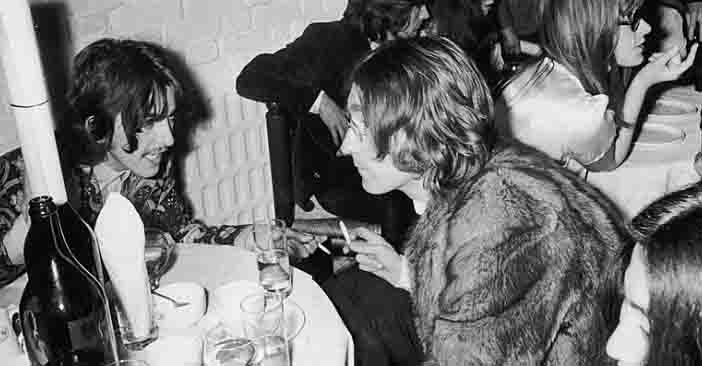
Harrison’s response to Lennon’s death came at a time when the pair were on the outs. Indeed, the only time that Harrison and Lennon became close was when they experimented with LSD.
But when the Beatles quit drugs, the animosity between Harrison and Lennon returned, especially as Lennon’s new partner, Yoko Ono, began to consume much of the affection Lennon still had for Harrison.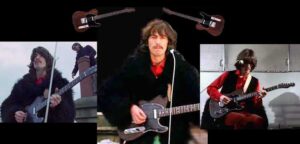
When the lead guitar player quit the band suddenly in January 1969, The Beatles considered various ways to replace him before acknowledging they couldn’t.
George left that day (during the filming of Let It Be) partly because of his caught-on-camera dispute with Paul. Yet that wasn’t the only reason. According to legendary Beatles producer George Martin, simmering troubles between John and George actually led to a fistfight at the time.The fight that was ‘completely hushed up’ in 1969.
The most dangerous tensions during January, though, passed between Harrison and Lennon. After being sidelined for years, Harrison now found that Yoko Ono sometimes had a voice in band matters that equaled or even bested his.
There were only two options, “to oppose Yoko and get the Beatles back to four or to put up with her.” He opted for the latter, because he didn’t want to lose John. In addition, he said, he felt he had no place in telling John to leave Yoko at home. It did, however, always rankle McCartney when Ono would refer to the Beatles without “the” – as in, “Beatles will do this, Beatles will do that.” Paul tried to correct her – “Actually, it’s the Beatles, luv” – to no avail.
When you watch Let It Be, you see Paul patronizing George during their famous argument. Meanwhile, during a rehearsal of George’s “I Me Mine,” you see John whisk Yoko off for a waltz.
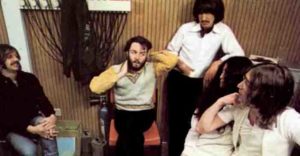
That grated on George’s nerves (as it would anyone).
Finally, Harrison reached a breaking point. Early in the afternoon of January 10th, Harrison and Lennon got into a fight that they had to later deny came to blows (though George Martin would tell Lennon biographer Philip Norman that the argument indeed became physical, but “was hushed up afterwards”). The moments of that confrontation are among the few that Lindsay-Hogg was unable to capture for posterity. He did, however, manage to film Harrison apparently quitting the Beatles. “I’m out of here,” he said, packing up his guitar. “Put an ad in newspapers and get a few people in. See you ’round the clubs.”
Yet over the next 10 days, The Beatles admitted they couldn’t just replace George with Eric Clapton; they needed their guitar player. Before he returned to the band, George demanded they move out of the studio where all the problems had arisen and nix the idea for a comeback live show.
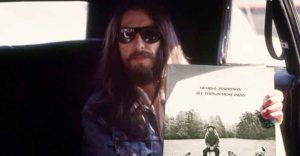
As for George and John, the two seemed to move on from the fight. In 1971, when John recorded his breakthrough debut solo album, he had George on slide guitar.
Four months after The Beatles had finally split, Harrison organized “The Concert for Bangladesh” at Madison Square Garden featuring the likes of Ringo Starr, Bob Dylan and Eric Clapton.
John Lennon was going to play, too — but “pulled out on discovering the invitation didn’t include Yoko,”