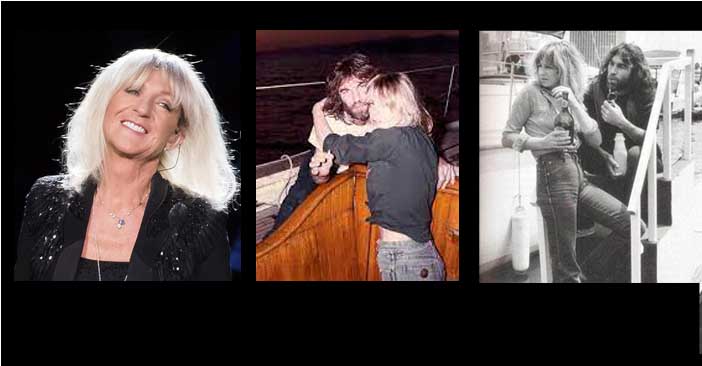
Drugs, booze, illicit sex and affairs simply took their toll, and as their relationships fell apart, Christine, Stevie and Lindsey all separately brought to the table cathartic pieces that laid bare their own pain, anger, despair – and a little hope.

Christine McVie is the subject of a new biography, Songbird: An Intimate Biography of Christine McVie, from author Lesley-Ann Jones. The 352-page book arrives November 19, 2024, via Hachette Books in the U.S.: and Nov. 14 in the U.K. from publisher John Blake. [It was originally titled Perfect after McVie’s original surname, with a June 20 publication date, since pushed back.] It can be pre-ordered in the U.S. here and in the U.K. here.
Lesley-Ann Jones shares her memories of the Fleetwood Mac legend Told by an author who herself was friends with Christine, and with new contributions from those who knew her best, Songbird offers a true insider’s view, and deep psychological insight into its subject as a both a woman and a musician – the first, the only, the ultimate picture of a rock legend and a national treasure.

We stood with our backs to the kitchen wall at somebody’s New Year’s Eve party in Los Angeles. “The older you get, the quieter you become,” reflected Christine McVie, clutching a crystal flute of champagne but not sipping a drop. Suddenly, she crossed the room to tip hers in the sink, then re-joined me at the edge of the fray.
Seizing my glass, she gulped it in one, then fell about, cackling. It was a jokey nod to her heavy drinking.
“Life humbles you bit by bit,” the Fleetwood Mac singer, songwriter and keyboardist – who died on Nov 30, aged 79 after a short illness – mused to this rookie upstart, who probably shouldn’t have been there in the first place.
It was January 1984. A week or so earlier, on December 28, Chris’s former lover, Beach Boy Dennis Wilson, had gone overboard from a yacht called Emerald moored at Marina del Rey. Drugs, booze and freezing seawater did for him. He was just 39.
Chris heard about the tragedy in a call from her PA, who phoned at the ungodly rockstar hour of 8am to inform her boss Dennis had drowned.
“Is he all right?” Chris asked. Convinced the hell-raising love of her life was indestructible, she could not compute “drowned” meant “dead”.
I persuaded my new friend to invite me to her home to talk further.
Days later, I drove through the entrance of a gated estate in the Crest Streets enclave of Beverly Hills for the first of many encounters over the next few years.
I was confronted by what looked like a lavish English country mansion which, I later learnt, had once belonged to Joan Collins and, separately, Elton John.
It was an ironic statement from the only surfer in the 60s surf-boy supergroup. Christine, by her own admission, had made a cocaine addict of him.
The most outrageously decadent band of the 70s and 80s, Fleetwood Mac were legendary for ploughing their way through gargantuan quantities of the drug, as well as for wrecking relationships and breaking hearts as they wenched and wassailed across the globe.
Dennis was a magnet,” she said. “He drew you to him. He drew everybody to him. The guy sitting in the seat beside him on a plane, the woman behind the counter in a shop. They’d become his best friends overnight. He was the Pied Piper, he collected people. He certainly magnetised me. I couldn’t resist him.
“We convinced ourselves that we were fated to be together. Our relationship was a dark and destructive fantasy. When I think about it, that’s what Fleetwood Mac was, too.
“But I am grateful to him. For having awakened aspects of myself that I had always been afraid to experience. I was beholden to a somewhat cold, Northern streak.”
“But ultimately, his craziness drove us apart. He’d go off for days on end and come back so slaughtered, I’d have to clean him up, wipe his bottom, wash off his sick.
"I became Dennis’s mother and that finished us. I was already known as the mother of the band.
“I didn’t have kids. Life on the road in a rock band is not conducive to raising children, whatever they tell you. My songs were my children. I didn’t have it in me to be maternal towards Dennis as well.”
John and Christine
Christine knew that John was a drinker when she married him. ‘He drank to cope,’ she said, ‘with who he was and who he wasn’t.’ Divorce in the late sixties was a dirty word, but they lasted only eight years. Having called time on their impossible marriage, Christine appeared resigned. She was, nonetheless, able to rise above her feelings: she was still willing to work with John, provided he controlled himself and behaved like a mature adult. He could do this when he was sober, but he lamented their distance when in his cups. He must have known as well as Christine did that they were beyond reconciliation.
He may also have been wracked by jealousy. For Christine was now, in 1976, having an affair with a Fleetwood Mac hand: their suave lighting director, Curry Grant. Their relationship provided light, no-strings relief from the shame and heartache of her ruined marriage. Although the couple lived together for about a year at her West Hollywood home, she regarded their set-up as a convenience and reflected its status in her song You Make Loving Fun. (The Telegraph)