The Beatles were at the height of their immense popularity when the tape was recorded at Scottish Television studios on April 30, 1964. The band had recently toured America, winning huge audiences on the Ed Sullivan show and shooting to the top of the charts on both sides of the Atlantic.
The interview was only broadcast in Scotland and sat in a film canister until it was discovered by film historian Richard Jeffs, who was astonished to find the familiar Liverpudlian accents of the Beatles on the tape. It was not immediately clear who owned the garage or why the film was there.
The audio portion of the tape was found to be still usable for radio broadcast, allowing the British Broadcasting Corp. to showcase its interview 44 years after it was recorded.
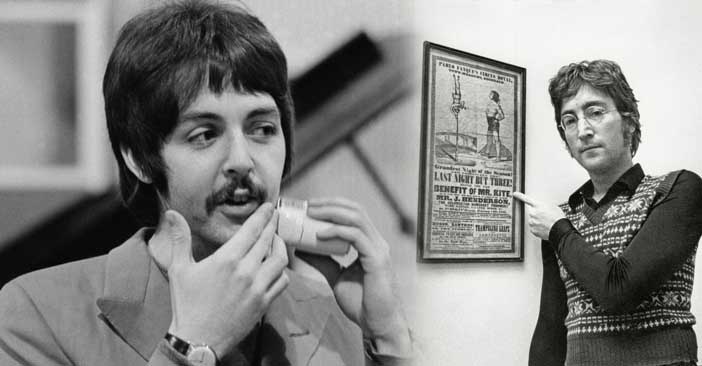
On the nine-minute tape, Lennon describes the fateful day in rock-and-roll history when he first encountered McCartney. Both were unknown teenagers at the time.
"I was playing at a garden fete in the ... village where I lived just outside Liverpool, playing with a group, and he came along and we met," said Lennon, who was a member of a soon-to-be-forgotten skiffle band at the time.
McCartney said they were introduced by a mutual friend called Ivan.
Lennon and McCartney became fast friends — once they found out they had skills in common, and a shared taste for American stars like Fats Domino and Little Richard — and they soon joined up with teenage guitarist George Harrison to form the nucleus of what would become the Beatles.
Drummer Ringo Starr would come much later, just before the group started its string of unforgettable No. 1 hits.
On the tape, Lennon and McCartney — hailed by many as the finest British songwriters of the 20th century — discussed the haphazard way they composed together during the Beatles' early days, when they were under intense pressure to generate hits while keeping up a bone-crushing touring schedule.
McCartney said that the two usually worked on songs together but that sometimes Lennon wrote songs completely on his own.
"Normally we sit down and try and bash one out," said McCartney. "But then again, there's no formula, because he (Lennon) can come up with one one day completely finished. We still say we both wrote it, though."
The two principal songwriters, who would later have a falling-out as the band was breaking up, sounded extremely relaxed and affectionate with each other.
McCartney said they used whatever instrument was available when composing. "Well, you know, it depends," he said. "Sometimes we write them on old pianos, anything that's lying around."
McCartney, who would later pen classics such as "Eleanor Rigby" and "Let It Be," told the interviewers that he and Lennon started off writing comical songs, including his first effort, the largely forgotten, "I Lost My Little Girl."
While the Beatles eventually wearied of the pressures of live performances, when they couldn't hear their own songs because of the noise from the fans, McCartney said in 1964 that they adored the attention they received from their screaming, fainting female fans.
"We love that," he said. "The atmosphere in the theaters. It's marvelous."
The Lost Beatles Interview
It was shortly before their American tour that I met them in their dressing room of the Finsbury Park Astoria here in London. John Lennon, Paul McCartney, George Harrison and Ringo Starr, a few minutes before they went on the stage. And as you’ll hear anything goes in a Beatles interview, my reputation probably too.
I started by asking the ringleader, John Lennon, how they all began.
John – Well (laughter) I don’t know, it just started about three years ago, in Liverpool, and we Beatled about, and then we went to Hamburg, and Beatled, and we came back to Liverpool and Beatled, and then we went to Hamburg and Beatled, then we came back to Liverpool and Beatled, and then we made a record.
Jacob – Why Beatle?
John – Why not? A rose by any other name would smell as Beatle.
Jacob – Hmmm (laughter)
Jacob – Let’s turn to Paul McCartney. Did you at that time…
Paul – Yes Bob?
Jacob – Yes, who did you say, Pop?
Paul – No, Bob.
Jacob – Bob?
Paul – Yes.
Jacob – I’m not Bob. (laughter)
Paul – Well there you go, don’t you? (laughter)
Jacob – Go on. Ya-kob.
Paul – Ya-kob. There Yakob.
Jacob – Good. Uh Paul, when you were still at school and you started this skiffle group, did you have any idea that you were going to sit here in the Astoria, that you were going on Royal Command performances, on trips to the States?
Paul – No I didn’t have any idea at all, Bob. About that. No idea at all, because you know, you just don’t think of that sort of thing do you Bob?
Jacob – No you don’t, Bob, but did you have any dreams, Bob? (laughter)
Paul – Now don’t start calling me Bob! (laughter) Well you know you obviously dream about that sort of thing, but you never think it will really happen to you.
Jacob – What would you be doing now if you hadn’t been a Beatle?
Paul – I think really what I might have been doing was teaching, but I was saved in the nick of time. But this is the life for me, hey, Bob? (laughter) OK Bob?
Jacob – Thanks very much, Bob.
Paul – OK All the best.
Jacob – Let’s turn to the other Bob, George Harrison. George, aren’t you sometimes frightened by all this adulation, the hysteria that you create amongst the teenaged fans?
George – Nah, not at all, Dave. I mean, I’d be frightened if they all stopped shouting and screaming, coming to see the shows. Sometimes you do get a bit worried if something goes wrong and somebody’s got hold of you by the hair but it doesn’t really matter.
Jacob – It’s not Dave by the way, it’s Charles.
Paul – Don’t let things like that get you down, will you…
Jacob – I don’t mind at all…
Paul – I’ve known some people go through life with names like Rudolph and things but they just don’t seem to worry about it.
Jacob – Well Rudolph is almost as good as Ringo, isn’t it? Ringo you were the last to join them?
Ringo – Yeah, because they’re a bit older than I am. (laughter) I’d only just started school when they started. It’s not a lie.
Jacob – Have they been to school? I didn’t…
Ringo – Oh, yes, yes, Paul was there Tuesday, May, 1964.
Jacob – But John, coming back to you, this question of the hysteria. When they storm you after a show, and you know, tear the clothes off your back, aren’t you really afraid?
John – Well I’ve never had ’em, I’ve only lost a button I think in eight months.
Jacob – Not a vital one I hope.
John – Oh no that one has zips.
Jacob – Now, how much longer do you think this Beatling is going to last?
John – Well about five hours I think.
Jacob – Ah, no no, that’s tonight.
John – Oh yes, well, I don’t know, if I knew I’d take out an insurance about it.
Jacob – Well what are you going to do afterwards?
John – I’m going to retire.
Jacob – You’ve made enough money, have you?
John – Well if we kept it on for four or five years we will have.
Jacob – What are you going to do with all that money?
John – I don’t know, I think, you know, I might go into recording myself. As long as you’ve got the money it doesn’t matter.
Jacob – Paul, what about you?
Paul – What was the question you asked me, I didn’t…could you please rephrase that?
Jacob – Yes, I said if everything dries up now, the golden and silver discs and things like that, what would you do?
George or Ringo? – (background) Melt them down.
Paul – It’s an interesting question that, I think as far as I’m concerned, I might just carry on with the song writing bit, you see, because John and I have been writing these songs for about two years now, and I think that even if our popularity waned, (waned – it’s the way I say it) we might still carry on writing these songs, whiting these songs I should say.
Jacob – You and John are of course the two writers of the group, Ringo…