The following is an excerpt from the book Paul McCartney: Many Years From Now by Barry MilesPublished by Henry Holt and Company, Copyright © 1997 Barry Miles.
Sgt. Pepper
Paul, with Mal Evans, had a relaxing safari in Kenya, returning to London on 19 November 1966. It was on the flight back that Paul came up with the idea for Sergeant Pepper's Lonely Hearts Club Band.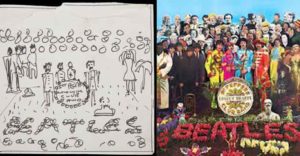
PAUL: We were fed up with being the Beatles. We really hated that f------ four little mop-top boys approach. We were not boys, we were men. It was all gone, all that boy s---, all that screaming, we didn't want any more, plus, we'd now got turned on to pot and thought of ourselves as artists rather than just performers. There was now more to it; not only had John and I been writing, George had been writing, we'd been in films, John had written books, so it was natural that we should become artists.
The first thing Paul needed was a name for the Doppelganger-Beatles. This was the heyday of fantastically named groups: the Nitty Gritty Dirt Band, Country Joe and the Fish, Lothar and the Hand People, Big Brother and the Holding Company, Quicksilver Messenger Service, the Bonzo Dog Doo-Dah Band. Precedents for extravagance were not hard to find.
PAUL: Me and Mal often bantered words about which led to the rumour that he thought of the name Sergeant Pepper, but I think it would be much more likely that it was me saying, 'Think of names.' We were having our meal and they had those little packets marked 'S' and 'P'. Mal said, 'What's that mean? Oh, salt and pepper.' We had a joke about that. So I said, 'Sergeant Pepper,' just to, vary it, 'Sergeant Pepper, salt and pepper,' an aural pun, not mishearing him but just playing with the words.
Back in London, Paul put the idea to the other Beatles.
PAUL: They were a bit bemused at first, I think, but they said, 'Yeah, that'll be great.' There wasn't any hard sell needed. Everyone was into it. It was a direction for an album. I had the name so then it was, 'Let's find roles for these people. Let's even get costumes for them for the album cover. Let them all choose what they want.' We didn't go as far as getting names for ourselves, but I wanted a background for the group, so I asked everyone in the group to write down whoever their idols were, whoever you loved.
And it got quite funny, footballers: Dixie Dean, who's an old Everton footballer, Billy Liddle's a Liverpool player. The kind of people we'd heard our parents talk about, we didn't really know about people like Dixie Dean. There's a few like that, and then folk heroes like Albert Einstein and Aldous Huxley, all the influences from Indica like William Burroughs, and of course John, the rebel, put in Hitler and Jesus, which EMI wouldn't allow, but that was John. I think John often did that just for effect really. I first of all envisioned a photograph the group just sitting with a line of portraits of Marlon Brando, James Dean, Einstein and everyone around them in a sitting room, and we'd just sit there as a portrait.
We were starting to amass a list of who everybody's favourites were, and I started to get this idea that Beatles were in a park up north somewhere and it was very municipal, it was very council. I like that northern thing very much, which is what we were, where we were from. I had the idea to be in a park and in front of us to have a huge floral clock, which is a big feature of all those parks: Harrogate, everywhere, every park you went into then had a floral clock. We were sitting around talking about it, 'Why do they do a clock made out of flowers?' Very conceptual, it never moves, it just grows and time is therefore nonexistent, but the clock is growing and it was like, 'Wooah! The frozen floral clock.'
Only later in the recording did Neil Aspinall have the idea of repeating the 'Sgt. Pepper' song as a reprise, and the Beatles and George Martin begin to use linking tracks and segues to pull it all together, making it into more of a concept album.
Recording sessions for the Beatles' new album began on 24 November 1966. 'Strawberry Fields Forever' and 'Penny Lane' were the first and third songs completed, with 'When I'm Sixty-Four' in between; but Paul does not remember any overt decision by himself and John to write songs with a northern theme, even though these first two would indicate a concept album along those lines. As it happened, Brian Epstein decided that the Beatles needed a new single and both tracks were pulled for this, though initially the single was to be 'Strawberry Fields Forever' backed with 'When I'm Sixty-Four'. The Beatles' practice at the time was to never put singles on albums.
John wrote 'Strawberry Fields Forever' in Almeria, Spain, while he was filming How I Won the War with Richard Lester. It is a memory song, about the Salvation Army hostel near his home in Liverpool.
PAUL: I've seen Strawberry Fields described as a dull, grimy place next door to him that John imagined to be a beautiful place, but in the summer it wasn't dull and grimy at all: it was a secret garden. John's memory of it wasn't to do with the fact that it was a Salvation Army home; that was up at the house. There was a wall you could bunk over and it was a rather wild garden, it wasn't manicured at all, so it was easy to hide in. The bit he went into was a secret garden like in The Lion, the Witch and the Wardrobe and he thought of it like that, it was a little hide-away for him where he could maybe have a smoke, live in his dreams a little, so it was a get-away. It was an escape for John.
Perhaps inspired by John's nostalgia, Paul then wrote 'Penny Lane':
I think we wrote them round about the same time, we were often answering each other's songs so it might well have been my version of a memory song but I don't recall. It was childhood reminiscences: there is a bus stop called Penny Lane. There was a barber shop called Bioletti's with head shots of the haircuts you can have in the window and I just took it all and arted it up a little bit to make it sound like he was having a picture exhibition in his window. It was all based on real things; there was a bank on the corner so I imagined the banker, it was not a real person, and his slightly dubious habits and the little children laughing at him, and the pouring rain. The fire station was a bit of poetic licence; there's a fire station about half a mile down the road, not actually in Penny Lane, but we needed a third verse so we took that and I was very pleased with the line 'It's a clean machine'. I still like that as a phrase, you occasionally hit a lucky little phrase and it becomes more than a phrase. So the banker and the barber shop and the fire station were all real locations.
There is 'a shelter in the middle of the roundabout' at Smithdown Place, known to the locals as the Penny Lane Roundabout, where Church Road meets Smithdown Road. It is now occupied by a cafe, but was then used as a place to meet people or shelter while waiting for a bus.
PAUL: John and I would often meet at Penny Lane. That was where someone would stand and sell you poppies each year on British Legion poppy day; where John and I would put a shilling in the can and get ourselves a poppy. That was a memory. We fantasised the nurse selling poppies from a tray, which Americans used to think was puppies! Which again is an interesting image. I was a choirboy at a church opposite called St Barnabas so it had a lot of associations for me.
When I came to write it, John came over and helped me with the third verse, as often was the case. We were writing childhood memories: recently faded memories from eight or ten years before, so it was a recent nostalgia, pleasant memories for both of us. All the places were still there, and because we remembered it so clearly we could have gone on.
On the corner of Smithdown Place, next to the bank, stood the showroom of photographer Albert Marrion, who took the first official portraits of the Beatles -- chosen by Brian Epstein because he had done the pictures for Clive Epstein's wedding. The window displayed formal portraits, including one mounted artistically upon an easel. Paul: 'I often used to stop in front of Albert Marrion's, who did high-class photography and wedding photos; we once had our picture taken by him, so there could have been a fourth verse about a photographer, but the song was finished before we needed any more characters. Penny Lane was a place with a lot of character and a lot of characters, good material for writing.'