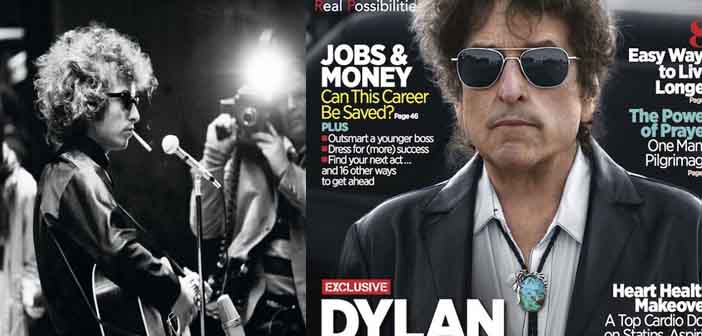
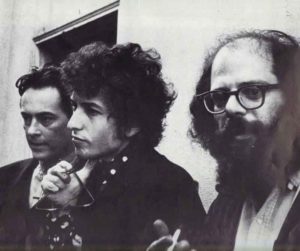
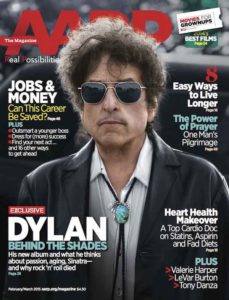
It turns out the editor-in-chief Robert Love used to work at Rolling Stone, which is why Dylan reached out to him. “‘I don’t work at RS anymore,’ I told [Dylan’s representatives], thinking it was a case of crossed wires, since I put in 20 years there. No, they said, there’s no mistake; he wants to talk to your readers…”
On the cover were the words, Dylan Behind the Shades: his new album and what he thinks about passion, aging, Sinatra — and why rock ’n’ roll died.
From its fused inception, rock ‘n’ roll was already a racially integrated American invention being blasted in teenage bedrooms as early as 1955, but as the Civil Rights Movement was gaining momentum going into 1960, the genre was being commercially segregated, on the sly, into white (British Invasion) and black (soul) music by the (WASPy) establishment.
Dylan discussing the production of his recent album, the fact that his band was made up of old-timer elements like the pedal steel and stand up bass, and that there were no overdubs or separate tracking and it all sounds great. But when the conversation moves into his early influences during childhood, he goes off onto a tangent about rock ’n’ roll.
“I was still an aspiring rock n roller. The descendant, if you will, of the first generation of guys who played rock ’n’ roll — who were thrown down. Buddy Holly, Little Richard, Chuck Berry, Carl Perkins, Gene Vincent, Jerry Lee Lewis. They played this type of music that was black and white. Extremely incendiary. Your clothes could catch fire. When I first heard Chuck Berry, I didn’t consider that he was black. I thought he was a hillbilly. Little did I know, he was a great poet, too. And there must have been some elitist power that had to get rid of all these guys, to strike down rock ’n’ roll for what it was and what it represented — not least of all being a black-and-white thing.”
Love probed further, asking Dylan, “Do you mean it’s musical race-mixing and that’s what made it dangerous?”
“Racial prejudice has been around awhile, so, yeah. And that was extremely threatening for the city fathers, I would think. When they finally recognized what it was, they had to dismantle it, which they did, starting with payola scandals. The black element was turned into soul music, and the white element was turned into English pop. They separated it […] Well, it was apart of my DNA, so it never disappeared from me. I just incorporated it into other aspects of what I was doing. I don’t know if this answers the question. [Laughs.] I can’t remember what the question was.”
It was jarring how he tossed it into the conversation so casually, a fun little tidbit, like, oh, by the way, real rock barely saw the 60’s before it was hijacked, fractured, and packaged to different demographics (of color).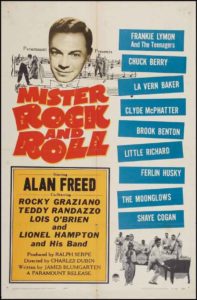
The payola scandals he’s talking about came about when it was revealed labels and distributing companies were bribing disc jockeys to spin certain records a certain amount of times per week. Before DJ’s were known as the lucrative, technical button-pushers they are today, they were lucrative curators of music trends in the 1950’s, when cheap 45 rpm’s took off and the American teenager (*Boomer alert*) was, for the first time, a viable economic force.
In 1950, there were approximately 250 disc jockeys in the U.S. By 1957, the number had grown to over 5,000. The increase was partially due to the sheer amount of new records being produced, both by major and indie labels. As the name suggests, a disc jockey was responsible for sorting through all these releases (naturally, the sorting was influenced by payola). These on-air personalities had so much clout with younger listeners, Time magazine called them the “poo-bahs of musical fashion and pillars of U.S. low- and middle-brow culture.”
It took exposés from Billboard and Variety to finally call it out for what it was, demanding reform in the business. Billboard even took the discerning effort to write, “The cancer of payola cannot be pinned on rock ’n’ roll.” The hammer eventually came down in 1959, when 335 DJs admitted to receiving over $263,000 in “consulting fees” before the U.S. House Oversight Committee (that’s over $2.1 million in today’s money).
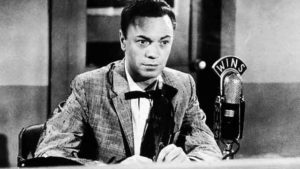
That figure was only the tip of the payola iceberg (before the hearings, Phil Lind, a DJ at Chicago’s WAIT had confessed that he had once taken $22,000 to play a single record). The trial heated up when the two most influential jocks in the country took the stand. Alan Freed and Dick Clark both played important parts in the rise of rock ’n’ roll (Freed embodied the incendiary spirit of the music more than Clark, refusing to play white cover versions of black songs, such as Pat Boone’s “Tutti Frutti”). And though they both denied ever accepting payola, it’s almost impossible to imagine two young, popular jocks not succumbing to a little temptation. Guilty or not, it was Freed who ended up taking the fall for DJs everywhere.
 Sinatra had his own thoughts on the matter. In a 1957 article he penned in the Los Angeles Mirror News, he laid his disdain down pretty thick:
“My only deep sorrow is the unrelenting insistence of recording and motion picture companies upon purveying the most brutal, ugly, degenerate, vicious form of expression it has been my displeasure to hear — Naturally I refer to the bulk of rock ’n’ roll. It fosters almost totally negative and destructive reactions in young people. It smells phony and false. It is sung, played and written for the most part by cretinous goons and by means of its almost imbecilic reiterations and sly, lewd — in plain fact, dirty — lyrics, and as I said before, it manages to be the martial music of every sideburned delinquent on the face of the earth … this rancid-smelling aphorodisiac I deplore.”
This created a momentary rift between Elvis and Sinatra fans. In fact, it illustrates that there were always trolls quick to call a celebrity out, even ‘Ol Blue Eyes himself. Via letters to the editors of Herald-Express, teenage girl Elvis fans called Sinatra a “crabapple” after his denigrating comments. They went on to say, “[Elvis] is a gentleman and if you and others had brains, you would know that he wiggles around because he shows what’s in his heart. The reason Frank Sinatra doesn’t like Elvis is because he can’t wiggle around and he’s just jealous. Why? Because he’s an old croney.”
All of this certainly puts a heavier frame around “The Day The Music Died,” an American tragedy eerily telling of the music world at the time. 1959 proved an apocalyptic year in music. It started with the fateful plane crash in February that took the lives of Valens, Buddy Holly, and J.P. “the Big Bopper” Richardson in one ruthless, horrific swoop. It ended in December with Chuck Berry, now one of the biggest pop stars in the country, getting arrested under moot allegations. Specifically, “for transporting a minor across state lines for immoral purposes in violation of the Mann Act.” This, by the way, was shortly after he had established a racially integrated night club in St. Louis called Berry’s Club Bandstand. Berry had won an appeal, claiming the judge’s comments and attitude were racist, but after being retried, he was given a three year sentence. While in prison, Berry wrote a few songs, including “You Never Can Tell,” eternalized by Quentin Tarantino in 1994’s Pulp Fiction.
For the cherry on top, as mentioned, Alan Freed was thrown under the bus for payola — and the rest of us got stuck with Dick Clark on New Year’s Eve for the next 50 years.
Why did the committee single [Freed] out? Freed was abrasive. He consorted with black R&B musicians. He jive talked, smoked constantly and looked like an insomniac. Clark was squeaky clean, Brylcreemed, handsome and polite. At least on the surface. Once the grilling started, Freed’s friends and allies in broadcasting quickly deserted him. He refused — “on principle” — to sign an affidavit saying that he’d never accepted payola. WABC fired him, and he was charged with 26 counts of commercial bribery. Freed escaped with fines and a suspended jail sentence. He died five years later, broke and virtually forgotten.