Bob Dylan is 81 today. But what’s his greatest song? Stars pick their favourite – and recall their own encounter from Elton John to Bono, Joan Baez to Dave Stewart, tell about their personal encounters with Bob Dylan as the great singer-songwriter turns 81 on May 24th.
 In the song, 'Like a Rolling Stone' Dylan crucifies the crux of counterculture’s exposed achilleas heal—and he does it with such disdain that the world would never truly be the same when his cutting intellect, stirring poetry and the brilliance of the soaring melody all mingled into one pop culture opus.
When I heard ‘Like a Rolling Stone’,” Zappa told the writer Clinton Heylin, “I wanted to quit the music business.” That is quite a statement considering that when it was released in July 1965 Zappa was yet to release an official studio album and he would go on to unleash 62 of his own.
He continued: “I felt [that] if this wins and it does what it’s supposed to do, I don’t need to do anything else.” The song heralded the same sort of iconoclasm and societal incision that Zappa would champion throughout his career, but much like the moustachioed guitar God, Dylan’s anthem is actually more cult than you might think.
Excerpt from The Guardian, BBC, and others newspapers. I was playing Bob Dylan records at my parents’ house when he was still an acoustic folk singer, but he was already very important and his lyrics were on point. Desolation Row’s lyrics are just so interesting and diverse. It isn’t a real street so you create your own fantasy. I imagine an unforgiving place, somewhere you don’t want to spend much time, peopled with strange characters. The opening line about the “postcards of the hanging” sets the tone, but then this awful event is juxtaposed with “the beauty parlour filled with sailors” and all these circus people.
I first met Bob at the Savoy in 1965. There’s a clip of me and Joan Baez singing As Tears Go By (Watch HERE) in the hotel room while Bob is hammering away on a typewriter. Later when I turned him down, he told me that it had been a poem about me, but he’d torn it up.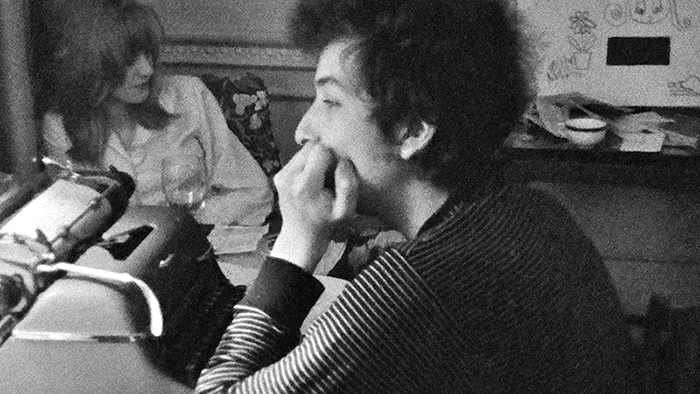
I was so upset, but we got over that and have been friends for 56 years. I really like him. I think It’s All Over Now, Baby Blue is about those times in life where you just have to say, “OK, we tried, it didn’t work”, but it’s a much sleeker way of saying it. It’s very loving, but obviously it’s all over. I don’t really know why I love it so much.
I was on tour in the States in the summer of ’65 with a British act, Peter and Gordon. Gordon Waller was a huge Dylan fan and played his records in the Holiday Inns. I wasn’t struck by Dylan’s voice at first but then I heard Blowin’ in the Wind and I’ve been a fan ever since. The lyrics are fantastic. He’s basically asking, “How many times do we have to go through all this shit before we realise that we’re fucking up the world?”
ELO’s Jeff Lynne, who made two albums with Dylan as part of the Traveling Wilburys in the 1980s, described him as “a very mysterious guy”. He wrote a poem for Marianne Faithfull in 1965, then tore it up when she declined to sleep with him. “That was a shame. Mad poet in terror!” noted Faithfull. “It’s very hard to say what Bob’s like, because he changes so much. He’s a very grand old man now, but in his youth he was really a shapeshifter.”
Dave Stewart summed up that elusive quality when he told Neil McCormick about going for a stroll through Camden Market with Dylan in 1993. Passers-by reacted with slack-jawed shock, as if they could not believe what they were witnessing. “It was like walking with a ghost,” was Stewart’s memorable phrase. Elton John once mistook a “scruffy” Dylan for a staff member at a party. “I loudly demanded to know what the gardener was doing helping himself to a drink.” When it was pointed out that this was Bob Dylan, Elton rushed to make amends: “Bob! Bob! We can’t have you in those terrible clothes, darling. Come upstairs and I will fit you out with some of mine at once.”
Leonard Cohen told a tale of his encounter with Dylan in Paris in the 1980s. Dylan praised Cohen’s Hallelujah (which he had been performing in concert) and asked how long it took to write. Cohen told him: “Oh, the best part of two years.” Feeling he should repay the compliment, Cohen praised Dylan’s song I &I and asked how long that had taken to write. “Oh, about 15 minutes,” responded Dylan.
Bono met Dylan in 1984, and the two have since become close. He often remarks on Dylan’s kindness and wisdom. During the recording of U2’s Rattle & Hum in 1988, Bono was invited to Dylan’s house in Malibu, where they wrote the song Love Rescue Me together in half an hour, with Dylan extemporizing fully formed verses. A studio session was quickly arranged, with Dylan playing keyboards and singing backing vocals. The band were making good progress when Dylan suddenly announced that they would have to scrap one of his verses. “What’s the problem?” inquired Bono. “I used it before,” Dylan admitted.
What’s So Great About… Bob Dylan? on BBC Radio 4 Extra will see Sir Lenny Henry question the musician’s greatness on May 24.
Patti Smith will celebrates Bob Dylan’s 80th Birthday at Outdoor Spring Festival
Upstate New York’s Kaatsbaan Cultural Park will host outdoor performances and panels in May.

“It’s gonna take a hundred years before they understand me!” Bob Dylan once claimed, “they” being the cohorts of fans, critics and Dylanologists who have dogged his tracks ever since Robert Zimmerman, chippy teen of Hibbing, Minnesota, became Bob Dylan, world-famous singer, songwriter, and pop’s most enduring enigma.
“That’s exactly the quote James Joyce made about Ulysses,” points out Sean Latham, professor of English at the University of Tulsa and head of the institute for Bob Dylan Studies recently established there. “Joyce said, ‘I put so many puzzles and enigmas in Ulysses it will take the scholars 100 years to solve them’.”