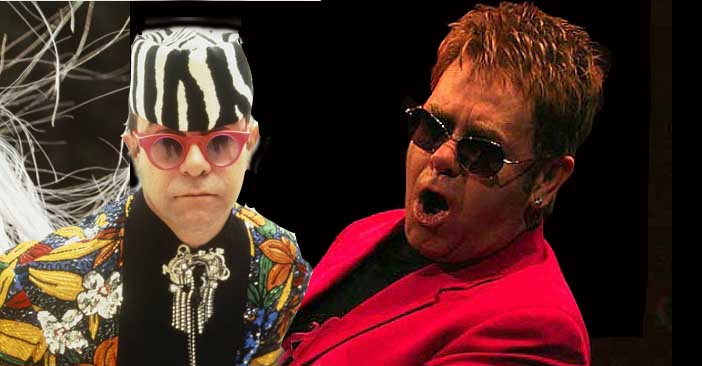
Elton John has called the legalisation of marijuana in America and Canada “one of the greatest mistakes of all time”.
Speaking with Time magazine, which selected John as the 2024 Icon of the Year, the legendary musician spoke of his past addiction and described marijuana’s impact on his mental health.
“I maintain that it’s addictive. It leads to other drugs. And when you’re stoned – and I’ve been stoned – you don’t think normally,” the 77-year-old said.
It’s tough to tell someone that they’re being an a******, and it’s tough to hear,” John said. “Eventually I made the choice to admit that I’m being an a******.”
His own experiences with weed have made him question the North American legalisation of marijuana. “Legalising marijuana in America and Canada is one of the greatest mistakes of all time,”
The pop superstar says he has lost his eyesight. But, from drug abuse to injuries, he has always taken adversity in his stride – and soared,
Elton is in the news again, this time contemplating blindness. At the West End premiere of his latest musical, The Devil Wears Prada, the now 77-year-old star admitted “I have lost my sight” and lamented that he had been unable to “see the performance.” He had previously told ABC’s Good Morning America that he was feeling “kind of stuck”.
“I can’t see anything, can’t read anything, can’t watch anything,” he said. “I can do something like this [an interview], but going into the studio and recording, I don’t know, because I can’t see a lyric for a start.”
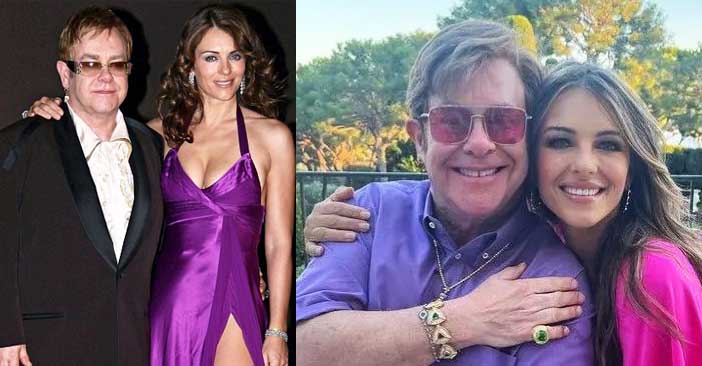
What is remarkable, however, is that there is very little sense of self-pity in Elton’s statements. He is a man who has come through a lot, taken it on the chin, and usually got back up and come out swinging. In terms of his health, he’s had battles with pneumonia and prostate cancer, along with joint issues restricting his mobility leading to many operations.
As he joked at the premiere of a recent Disney+ documentary about his career, Never Too Late: “I don’t have tonsils, adenoids or an appendix. I don’t have a prostate. I don’t have a right hip or a left knee or a right knee. In fact, the only thing left of me is my left hip. But I’m still here.”
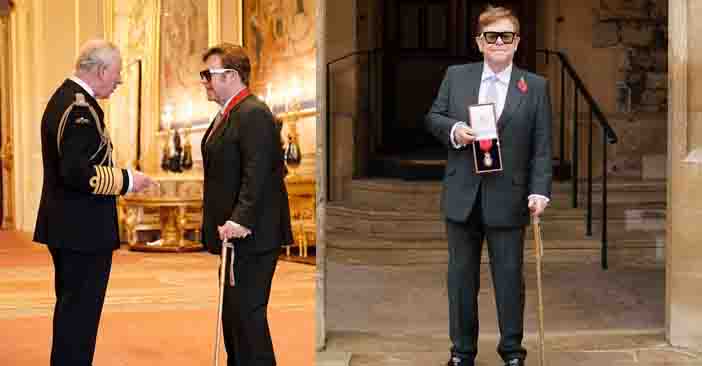
One thing you can say about his life and career is that he has faced trials and adversity with bravado and kept going against all kinds of odds.
He was painfully shy as a child and deeply afraid of his stern, bullying and emotionally distant father, who never came to terms with Elton’s sexuality or musicality, and never once came to see him perform live. His parents divorced when Elton (then plain Reg Dwight) was 14.
He was frequently at odds with his eccentric mother, to the point that they became completely estranged for eight years after she referred to his husband, David Furnishm as “that thing he married”. Elton grew up uncertain of his sexuality in an unforgiving world, at a time when homosexuality had only recently been decriminalised in the UK and USA, and was still considered career death for public figures.
His first long relationship with manager John Reid was reportedly often physically violent and abusive (Reid denies these allegations). Elton succumbed to alcoholism and addiction and can be heard admitting in the recent documentary that at the height of his 70s superstardom, “there was an emptiness within me.
My soul had gone dark. It was like I was dead.” He twice tried to commit suicide. The first incident was in 1968, when he was a struggling songwriter unhappily engaged to his first girlfriend. He tried to gas himself by sticking his head in an oven but was saved by the arrival of singer Long John Baldry, which ultimately inspired the song Someone Saved My Life Tonight.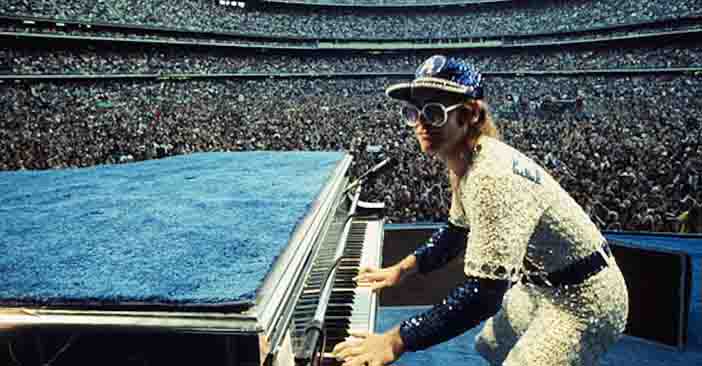
The second time, Elton took Valium and threw himself into a swimming pool at a house party in LA in 1975. An ambulance crew pumped his stomach and Elton went on to perform one of his most famous concerts at the Dodger’s Stadium two nights later. “It was one of the best days of my professional life, and I pulled it off,” he later said. “I am resilient. But I was not a happy bunny.”
Later, he lived as one of the first openly gay pop stars during the age of AIDS, when he lost many good friends, pushing him towards a life of activism on gay and health causes. He struggled with his addictions and ultimately overcame them in 1990, and has been sober now for 34 years – close on half his life.
And during all that time, through all the upheavals professional and emotional, he has kept making music. If Elton John stopped recording now, we would still have 35 studio albums to enjoy, along with another dozen albums of collaborations, soundtracks and original musicals.
There is a very long and honourable tradition linking blindness and music, from the blind traditional minstrels of Ukraine and the blind medieval folk musicians of Ireland to the travelling blind blues players of America, such as Blind Lemon Jefferson, Blind Willie McTell, Blind Willie Johnson, Blind Boy Fuller and Blind Blake.
Elton may not be able to read lyrics, but he can play, and he can sing, and he has plenty of loyal associates to help him find his way back to his songcraft.