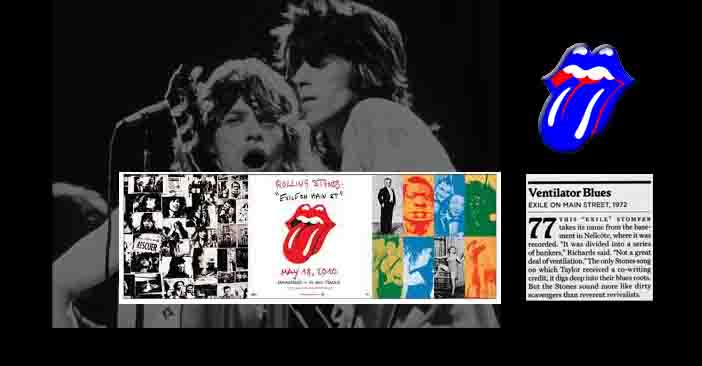
The making of the Rolling Stones’s Exile on Main Street is a rock legend. But what really happened in those long weeks of 1971? Lets looks back at a drug-fuelled marathon that still haunts the Côte d’Azur..
It was Jagger who hand-lettered Exile’s titles and credits, using pens and paper Van Hamersveld
had sent him. “And then those pieces of paper I pasted down, with tape, so that’s how you get that rough look. It doesn’t come from a typographer — it comes from Mick Jagger, with a pen in his hand.” (K.R.)
Keith Richards: “Writing ‘Tumbling Dice’ was a pain in the butt”
The Rolling Stones released “Tumbling Dice” on April 12, 1972.
A dizzying cast of characters passed through the doors and passed out beneath the chandeliers of the 16-bedroom former Nazi stronghold, including film stars (James Caan, Faye Dunaway), musicians (Gram Parsons, Bobby Keys, Nicky Hopkins), cult novelists (William Burroughs, Terry Southern) and an endless parade of local Marseilles groupies, drug dealers and even a troupe of Bengali drummers.
For a six-month stretch, the Stones swapped partners, ingested every available drug, set fires and nearly drove each other mad while crafting rock’s most decadent record, 1972’s “Exile on Main Street.”
“It was like a royal court where the nobles were sleeping with each other’s women,” says Greenfield, who spent two weeks living at Nellcote — and a third just hanging around — while on assignment for Rolling Stone that May. He wasn’t the only one to notice the band’s exploits.
“Everyone screwed everyone else’s wives and girlfriends,” Johns says. “That’s just the way it was, and you didn’t think too much about that.”
Jam sessions went on for days, with hundreds of takes of rambling songs that were never finished. It ended with a drug bust and Richards was banned from France for two years. The recording were made in the underground bunkers of the villa and the Stones were divided into a myriad of rooms, tells Richards that "the drums were put a room far away, the sax of his friend Bobby Keys and others were scattered somewhere. To reach them you had to follow the electric cables."
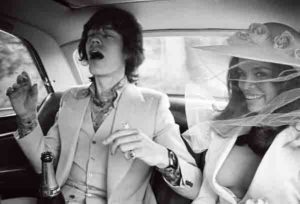
" Illegal power lines from the French railway system juiced their instruments, and when the temperature hit 100, they rehearsed with their pants off. A carnival of characters paraded through– Terry Southern, Gram Parsons, John Lennon, even a tribal band from Bengal… Dope dealers from Marseille; petty thieves, who stole most of the drugs and half the furniture; and hangers-on, all of them there to witness what was happening.” (K.R.)
DRUGS AND PILLS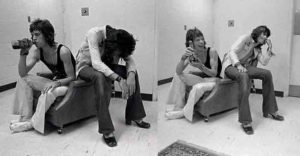
Jean de Breteuil, the so-called “dealer to the stars” who supplied Jim Morrison with a lethal dose, bought his way into a two-week residence with a toot of ultra-pure pink heroin from Thailand. Richards snorted it from a gold tube he wore around his neck and promptly passed out. Later, Richards paid $9,000 cash ($50,000 today) to a couple of cowboy boot-wearing dealers known as “the Corsicans” for more of the pink junk.
The smack arrived in a plastic bag the size of a two-pound sack of sugar, Greenfield writes, and was so potent it had to be cut 97 parts to 3 — hence its nickname, “cotton candy.” Richards recalls that the plastic bag lasted from June till November.
“With a hit of smack,” Richards says, “I could work through anything and not give a damn.”
“As a songwriter, Gram worked very much like I do, (Keith Richards says) which is knock out a couple of chords, start to spiel and see how far it can go. Rather than sitting around with a piece of paper and a pen, trying to make things fit neatly together, if you just get on the microphone, things come to you. Mick and Gram never really clicked, mainly because the Stones are such a tribal thing. At the same time, Mick was listening to what Gram was doing. Mick’s got ears.
Los Angeles also played a major part in Exile's creation, on multiple levels, says Keith Richards.
Musically, the Stones and producer Jimmy Miller finished up the album at Hollywood’s Sunset Sound, doing vocals, overdubs and mixing.
Wearing mirrored shades, red shirt and leather jacket while puffing a joint and standing inside a Bel-Air Spanish revival home, Keith Richards put his hands together to form a folded shape. “We can make some postcards,” he said. Then he fell to the floor, zonked.
In fact, Van Hamersveld says now, before those back-cover photos, “The album was just Exile.” After the photos, and Los Angeles, the album became Exile on Main St.
Venetta Fields got the phone call to come do Exile backing vocal sessions at Sunset Sound around midnight one evening in November 1971. She got the call after another singer had passed on the session because it was starting so late.Along with Clydie King and Sherlie Matthews, Fields contributed sanctified backing vocals on four tracks, she says: "Shine a Light,” "I Just Want to See His Face,” "Let It Loose" and the hit “Tumbling Dice,” which became a signature Stones tune.