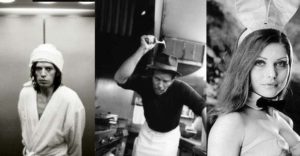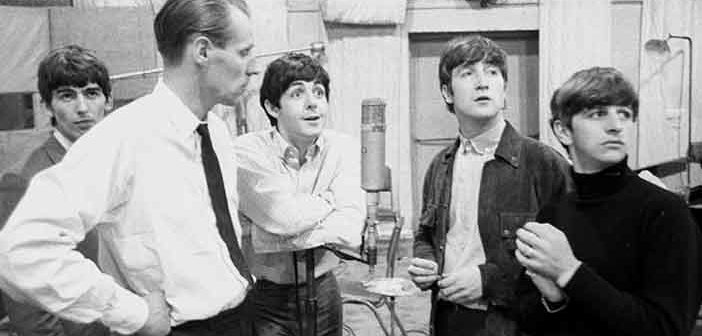
Beatles break up: this is an excerpt of the interview, the first time that it has appeared since 1974.
In your early days as a record producer, you built a reputation for versatility of product. In the last six years this has been overshadowed, perhaps lost, by your connection with the Beatles. Do you regret this? In today’s conditions do you think you can regain that reputation?
Not particularly; I suppose I have been too busy really to think about it. In any case, I have tried very hard to retain a certain versatility of product, if only to go on working with old friends. I don’t think I would consciously go out and say, “I must regain that reputation.” I do what I think I do best, and I will go on doing that as long as I want to. To worry about reputation–whatever it is–is narcissistic and unproductive.
Do you regret your decision to leave EMI?
No.
The history of so-called artistic partnerships is not a happy one. Have you regretted linking yourself with three other major record producers.
Not a bit. The partnerships at AIR have been a curiously successful one. I suppose I am the spearhead of the group, but it works well because we are four very different people dedicated to a common cause. I know I could not make records as well as Peter Sullivan in his particular field–every one of Tom Jones and Engelbert Humperdinck’s records required a special skill that he had. Equally, I know he could not have coped with the Beatles. We are complementary. We give each other something the other lacks and needs and, most important of all, we like each other. That is the basis of our company, and is to be found in any of the 35 people working together in AIR.
In America you are thought of as a millionaire. Are you?
Certainly not. I cannot say that I am not well off, but my assets are very much tied up in AIR. In any case, during the heyday of the Beatles (1962-1968) I worked for EMI on a small salary and had no participation at all in the profits and no royalties then.
Is it true that the chairman of Decca, immediately before the Beatles era, referred to your label [Parlophone] as “EMI’s junk label?”
It is possible. Certainly when I took over direction of Parlophone in 1955 I was aware that it was the poor relation of EMI. It had not had a real hit since before the war, when I was at school.
Is it true that Phil Spector remixed one of the albums you cut with the Beatles?
Let It Be was made before Abbey Road. It was made at a time when the first visible rifts were appearing between the Beatles. They were not happy days for the boys, and the result was not their best record. John was insistent that it should be a “live” album, and would not let me do any editing, any overdubbing or add any other instruments. Well, the final result was not bad; at least it was honest. When I heard the eventual disc the only person more surprised than I was Paul. John had brought in Phil Spector and did a lot of overdubbing of voice and adding various sugary sounds to the original album, reversing his original thoughts. It turned into the most un-Beatle album ever to be issued.
Do you think there is a significant relationship between music and drugs?
There has been, but not necessarily a benevolent one. A lot of music has been created in the past few years by “stoned” people for “stoned” people but I do not think it has elevated our music. I know that if I had been on drugs I could never have got Sgt. Pepper together.
Now that George Martin has died, there’s going to be a lot of (deserved) eulogies. And here’s another.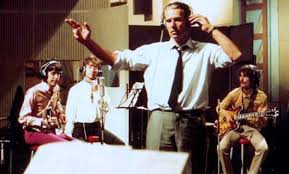
As the producer behind the vast majority of the Beatles’ massively popular and groundbreaking catalog, Working with the Beatles, solo Paul McCartney and others, he notched 23 No. 1 singles on the Billboard Hot 100 — more than any other producer. As we look back on his influence in the wake of his death, we’re looking at ten songs from the Beatles that wouldn’t have been the same without Martin’s input. Some were huge hits, others are essential album tracks, and all bear Martin’s impact.
This item could almost be a separate list in and of itself. The Beatles (and their recording engineers) either pioneered or popularized Artificial Double Tracking (ADT), back masking, tuned feedback, spliced audio loops, distortion, equalization, stereo effects, multi-tracking (overdubbing), compression, phase shifting, and innovative “microphoning.” Although the Beatles are not credited with the invention of most of these studio tricks, they were responsible for directly inspiring countless musical acts that were desperate to copy their unique sounds.
That’ll be talked about elsewhere no doubt, but I’d like to talk about George Martin — translator of musician nonsense.

(AP Photo/Stephan Chernin)
He still referred to affectionately as ‘the boysBeatles would be getting messy, and coming up with preposterous stoner ideas, and George — instead.’ The of muttering ‘for fuck’s sake’ or having it out with his charges and throwing his weight around like a lot of record producers did in the 60s and 70s — was ever the problem solver, and pragmatist.
“Eleanor Rigby”
While Martin’s orchestration on “Yesterday” was an exercise in beautiful restraint, his Bernard Herrmann-esque string octet orchestration for “Eleanor Rigby” is almost as essential to the song as its enigmatic lyrics. Martin’s staccato string section in the chorus is one of the most recognizable orchestral segments in all pop music.