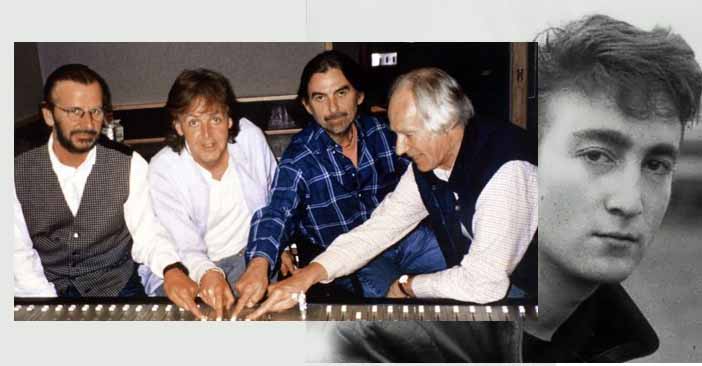
Contrary to the general understanding was John Lennon. Following the Beatles’ split in the early 1970s, Lennon mentioned that he wasn’t convinced that Martin had been as integral to their success as people gave him credit for.(FaroutMagazine)
In a 2007 interview with Mark Ellen for The Times, Martin explained, “My only regret with The Beatles is that I was wrongly advised and signed away my royalties to their records — about half a penny per title but, with them, that would have been an enormous amount.”
He continued, explaining that it wasn’t something he dwelled upon too much, “but I’ve got all the money I could want. People think I’m a multimillionaire and I’m not. I tend to look at people and think, ‘Are you a good human being?’ That’s what impresses me most rather than what they’ve achieved.”
“We’re a bit short on people like that at the moment – people who do good things and spread love for each other. We get an awful lot of people who are selfish. I think Margaret Thatcher started it, the greed thing, people just wanting more and more. And we’ve lost our morals to some extent. And the church has weakened. People don’t believe in anything apart from money and success. I know it’s easy for me to say as I’ve had some success, but I really believe family and love are more important than anything. Amore Solum Opus Est indeed!”
Giles Martin (Son of George) has posted a heartwarming clip of the late producer reminiscing about his introduction to the Beatles. "Well, that's a silly name for a start," he remembers saying.
Martin arranged an audition session on June 6, 1962, after they'd been memorably turned down by Decca Records. He decided the Beatles' original songs were still subpar, but that they showed great promise.(UCR)
"I met them in London and when I listened ... it was OK, but it wasn't brilliant," Martin told his granddaughter in a Twitter video posted below. "But the magic bit came when I started to get to know them because they were terribly good people."
I don’t normally share anything personal but this my dad from a while back explaining to my daughter he signed the Beatles. Ordinary people do extraordinary things. Great decisions are made for the simplest reasons. “I figured if I like them this much other people might too” ❤️ pic.twitter.com/j4bf96b4zS
— Giles Martin (@mashupmartin) January 19, 2022
"They were funny, they were very clever ... and they were the kind of people that you liked to be with," Martin adds. "So, I thought, 'If I feel this way about them, other people will feel this way about them.' So, therefore, they should be very popular."
In any case, during the heyday of the Beatles (1962-1968) I worked for EMI on a small salary and had no participation at all in the profits and no royalties then.When I took over direction of Parlophone in 1955 I was aware that it was the poor relation of EMI. It had not had a real hit since before the war, when I was at school.
"Let It Be was made before Abbey Road. It was made at a time when the first visible rifts were appearing between the Beatles. They were not happy days for the boys, and the result was not their best record. John was insistent that it should be a “live” album, and would not let me do any editing, any overdubbing or add any other instruments."
"Well, the final result was not bad; at least it was honest. When I heard the eventual disc the only person more surprised than I was Paul. John had brought in Phil Spector and did a lot of overdubbing of voice and adding various sugary sounds to the original album, reversing his original thoughts. It turned into the most un-Beatle album ever to be issued."
He still referred to affectionately as ‘the boysBeatles would be getting messy, and coming up with preposterous stoner ideas, and George — instead.’ The of muttering ‘for fuck’s sake’ or having it out with his charges and throwing his weight around like a lot of record producers did in the 60s and 70s — was ever the problem solver, and pragmatist.