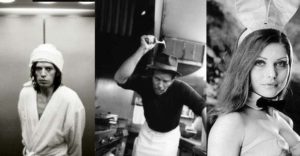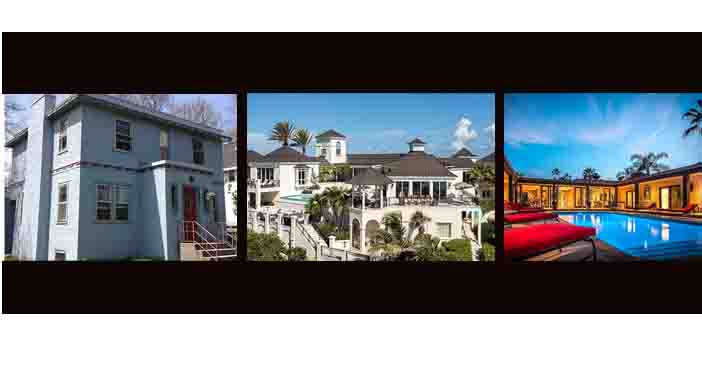
Main picture from left to right: Dylan house, Prince, Sonny & Cher
Bob Dylan's Childhood Home (Visit)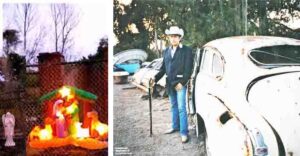
Bob Dylan’s family moved to Hibbing, Minn. when he was 6 years old. He remained in the charming three-bedroom house until he was in high school. Today, it’s owned by longtime fan Bill Pagel, who hopes to restore it to the way it was when Dylan’s family lived there. (UCR report)
Prince's Caribbean Villas (Rent)
Prince owned this luxurious vacation getaway in the Caribbean until his 2016 death. For 14k per night, fans can now book a stay at the Emara Estate, a colossal 17-bedroom spread that can accommodate up to 34 people split between two villas.
Sonny and Cher's Palm Springs Villa (Rent)
Pop culture icons Sonny and Cher once owned this Palm Springs Spanish style hideaway, which also hosted early Hollywood luminaries like Natalie Wood and Kirk Douglas.
Janis Joplin house: 635 Ashbury St., San Francisco
The legendary vocalist lived in a number of different locations in the City by the Bay, including a second floor apartment in this lovely Victorian located just steps from the famed Haight-Ashbury intersection .First on our list of the San Francisco music landmarks that rock ‘n’ roll fan needs to see is Janis Joplin’s house at 635 Ashbury Street.(click for the map)
By 1963, still making music, she had moved to San Francisco. During the two years that followed, her drug use increased and she acquired a reputation as a "speed freak" and occasional heroin user. She also used other psychoactive drugs and was a heavy drinker throughout her career.
In 1965, in a failed attempt to straighten out her life, she went back to Port Arthur. By then, she weighed only 88 pounds or 40 kilograms, and she changed her lifestyle. She avoided drugs and alcohol and enrolled as an anthropology major at Lamar University in nearby Beaumont, Texas. During her time at Lamar University, she commuted to Austin to sing solo, accompanying herself on acoustic guitar.
In '66, Joplin moved back to Haight, joined “Big Brother and the Holding Company”, partied with the Grateful Dead, and tried to avoid getting back on drugs. After appearing at the Monterey Pop Festival in August 1967, she and Big Brother came out with their untitled debut album. The album had four minor hits, including “Down on Me."
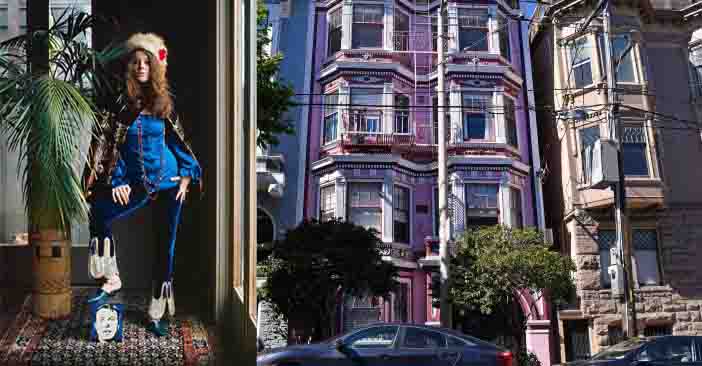
local landmarks are showcased in a new book, “Rock and Roll Explorer: Explorer Guide to San Francisco and the Bay Area” (Globe Pequot, $25), by Bay Area music writers Mike Katz and Crispin Kott.
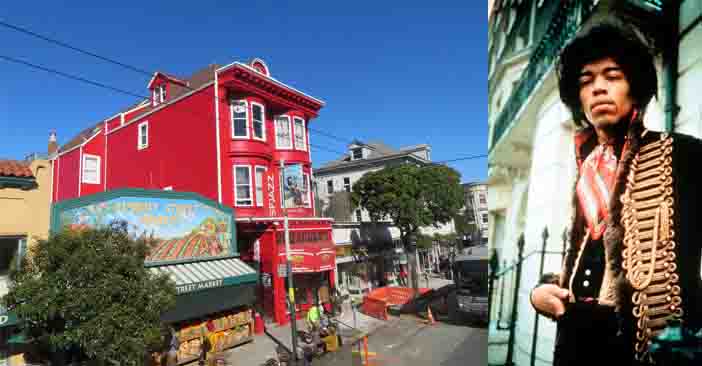
San Francisco also used to play home to Jimi Hendrix, whose former house still stands on 1524A Haight Street. A bit further away at 2400 Fulton Street but still in the same vein is the house where Jefferson Airplane recorded some of its most legendary albums and threw some of its most legendary parties. Meanwhile, at Justin Herman Plaza, you can see Vaillancourt Fountain, the site Bono sprayed with graffiti at U2’s legendary “Save The Yuppies” concert in 1987.
. Grace Slick house: 1310 Greenwood Ave., Palo Alto - CA -Slick (who was known as Grace Wing at the time) lived in this house with her family from the early 1950s until she left for college at the University of Miami.

Mike Katz and Crispin Kott, self-described “rock and roll soulmates,” have done it again. With the recently published Rock and Roll Explorer Guide to San Francisco and the Bay Area, they’ve captured the magical city’s musical legacy with the same tireless attention to detail, snappy writing and eye-catching graphics utilized to perfection in their previous Rock and Roll Explorer Guide to New York City. We spoke to Crispin and Mike to get the lowdown on the ‘City by the Bay’ to which Tony Bennett donated his heart.
Many years later in New York, Crispin and I attended a panel discussion with the surviving members of the Velvet Underground and listened to Lou Reed recount the many unexpected places where he and the others met, worked and essentially re-created themselves. We had talked about writing a book about New York’s rock ‘n’ roll history, but this was a ‘eureka’ moment.
Crispin Kott (CK): After New York we knew we either wanted to tackle the Bay Area or Los Angeles. We went with the Bay Area in part because there was so much more to the story than what happened in the second half of the ‘60s. All that is in here too, but the Haight-Ashbury scene wasn’t the beginning of rock music in the Bay Area, and it wasn’t the end, either.