Froont page splash of Melody Maker on May 22 1965 didn’t hold back. “Jackie leads chicks chart invasion!” it screamed, before explaining how Staffordshire’s Jackie Trent was “thrilled to bits” to be number one that week. The story then named all the other “chicks” riding high in the singles chart: among them, Marianne Faithfull, Sandie Shaw, Cilla Black and Françoise Hardy. (The Telegraph)
Hardy had become a pop phenomenon in the UK. Indeed the singer, who has died aged 80, seduced London and was seduced by it in equal measure.
She recorded much of her best work here and filmed pop videos in tourist-y locations: on the London Underground, next to Tower Bridge and even driving around Piccadilly on an open-top bus wearing pyjamas. She’d visit pubs and sip pints of bitter. It was quite the pivot for the poster girl of yé-yé, the jauntily breezy and manufactured French pop style through which she’d made her name back home.
It wasn’t only British pop fans who noticed Hardy. She drew the attention of Jagger and Rolling Stones bandmate Brian Jones. David Bowie admitted to being smitten with her. She had dinner with two Beatles. And tragic folk hero Nick Drake almost recorded with her. Her connections with British musicians didn’t end there. In 1995 when Britpop was at its height, Blur recorded their song To The End with Hardy singing the verses in French. It was released as the B-side to the band’s mockney cor-blimey-me-old-china single Country House – at the time the epitome of Britain’s pop cultural identity.
Hardy was in many ways doing a reverse Petula Clark. The Surrey singer had proved to be a big hit in France in the early 1960s.
Clark recorded songs by Serge Gainsbourg and Jacques Brel and moved to Paris for seven years. In a strange musical French exchange, Hardy did the precise opposite. “Many felt that Hardy’s career was paralleling that of Britain’s Petula Clark, who had moved to France and become a pop star there,” wrote pop historian Nick Johnstone in 1999.
Jagger once described her as the “ideal woman”. “I heard much later that there was a rumour that she was a lesbian, but really she was just shy and unsure. When Brian Jones introduced me to his girlfriend, Anita Pallenberg, I was very flattered and charmed, but then I heard that they were each trying to figure out which one of them I was interested in sexually,”
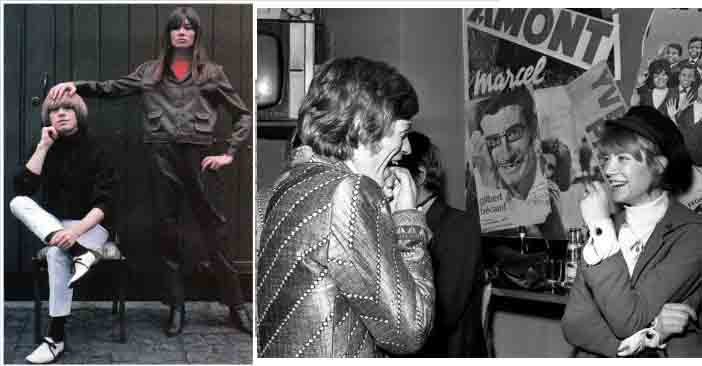
Hardy told The Guardian. “Of course, this was the very last thing I was interested in. I was unbelievably innocent.”
Bowie was a huge fan. “I was for a very long time passionately in love with her,” the singer told a French TV interviewer in January 1997. “As I’m sure she’s guessed, every male in the world and a number of females also were. And we all still are.” The appreciation was reciprocated – Hardy was herself a Bowie fan. Displaying admirable Gallic obtuseness, she once revealed her favourite Bowie track to be I’m Deranged from his 1995 album Outside, hardly a fan favourite. She told Bowie as much “and he was stunned. He couldn’t believe it. I think he was quite happy to hear that”.
“It was so odd that he would show up like without warning… He knew nothing about me and I knew nothing about him, and we didn’t try to get to know each other better. Did he expect something? A word, a gesture, a step? What had brought him to Paris? Could he have come because of me? This last possibility never crossed my mind,” Hardy said. Morton Jack has a theory about why young genius Drake revered the French singer so much: she “represented a vital link in his sense of relevance as a musician”.
It wasn’t only British artists who were mesmerised by Hardy. Bob Dylan, who like Jagger had appeared with her on that 1965 Melody Maker cover, wrote letters to Hardy. She always declined to reveal what they say. He also wrote an ode to her on the back of his 1964 album Another Side of Bob Dylan. “For Françoise Hardy, at the Seine’s edge…” it started.
But it Blur’s Alex James who best sums up the late singer. He describes spending an “enchanted afternoon” with Hardy in her Paris apartment – all “black walls and exquisite treasures” – with his bandmates in the mid-Nineties. “She was a truly beautiful woman, around fifty, skinny as an elf and confident, yet delicate,” he wrote in his autobiography A Bit of a Blur. France doesn’t have a royal family, he noted, but if it did, she would be its “fair queen”.