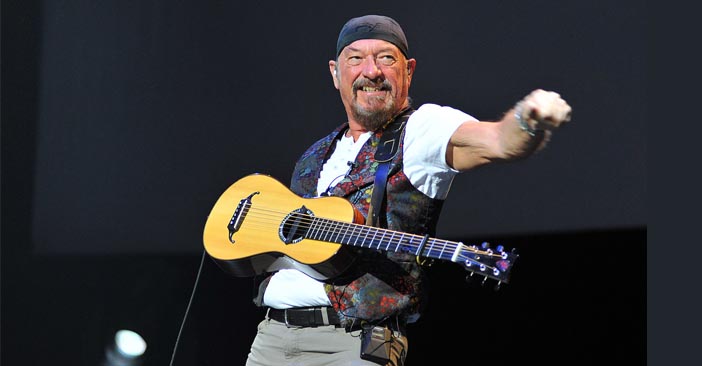
Anderson is likely pumping it directly into the sound board. So, it's getting a good EQ-ing, and a hefty dose of reverb. Pull the plug..
My first ownership of a musical instrument was the more than slightly disappointing result of mail-ordering a genuine high grade plastic Elvis Presley ukulele.
With imprinted likeness of the great man’s autograph and different coloured nylon strings, this wretched piece of tat was just about playable, but failed to stay in tune for more than thirty seconds. It was supplied with pitch pipes to enable tuning the notes of the open strings and a chord chart to songs like The Campdown Races and Yankee Doodle Dandy, which I could not remember Elvis actually having made famous. I was about nine at the time. (J.T.com)
At age eleven, I persuaded my father to buy for me a Spanish guitar, spied in a music shop in Edinburgh, where we lived, and suspiciously cheap at £5 ($8). This ferocious beast would not be tamed until fitted with steel strings and pressed into an orgy of three chord strumming with the young John Evan and Jeffery Hammond as reluctant witnesses, some five years later.
A solid electric guitar of nameless and vague origin came and went before the purchase of a true name instrument, the Harmony Stratotone. Sounds like a blonde bimbo-esque CNN presenter. Harmony and I taught each other the rudiments of Black American blues with a little help from our friends T-Bone Walker, Muddy Waters, John Lee Hooker .
Around this time, I coveted the Shure microphones used by some of the professional bands around the Blackpool area. Trading in the Fender, I acquired the services of a Shure Unidyne Three and, to pad out the part exchange, a shiny Selmer Gold Seal flute, in neat carry case with no playing instructions; not even in Japanese.
At this time in mid ’68, the Tull PA system was a brace of 30 watt Vox AC 30 guitar amps, wired through a little mixer made by someone called Edwards. It had five inputs and two mono outputs. Since one of the Vox’s was a bass model, you didn’t want to stand on the left side of the Marquee club when Tull were on if you wanted to hear the vocals.
The only guitar which I had retained, principally for writing songs, was the Harmony. My first Tull acoustic guitar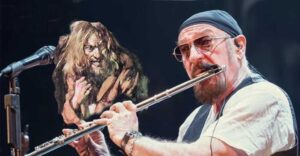 was a Yamaha, the cheapest model in their range.Martin Barre kindly gave me a Gibson SG pointy horn electric guitar which I ventured to use on the Benefit album, as occasional rhythm guitarist.
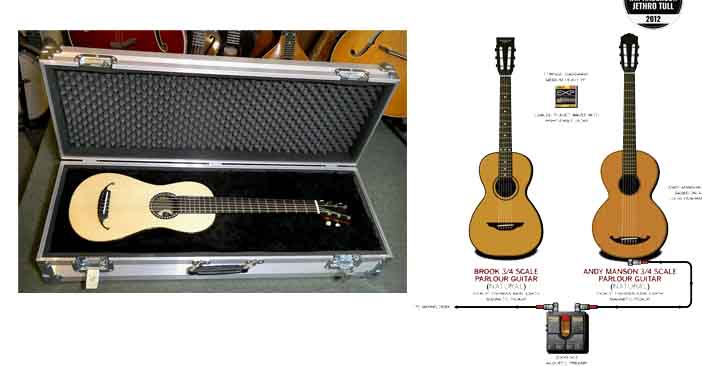
The guitar with which I am most associated, especially in the seventies, was the US produced Martin 0-16NY, a small bodied so-called “parlour” guitar which I first found in a shop (would you believe it?) in Tokyo during our first visit in 1972. I still own three of these guitars, although they have been reworked with slimmer contoured necks and new bridge pieces to improve intonation.
At the time of recording the “Aqualung” album, I was briefly playing an Aria Japanese guitar. By “A Passion Play”, I was on the Martin New Yorkers.
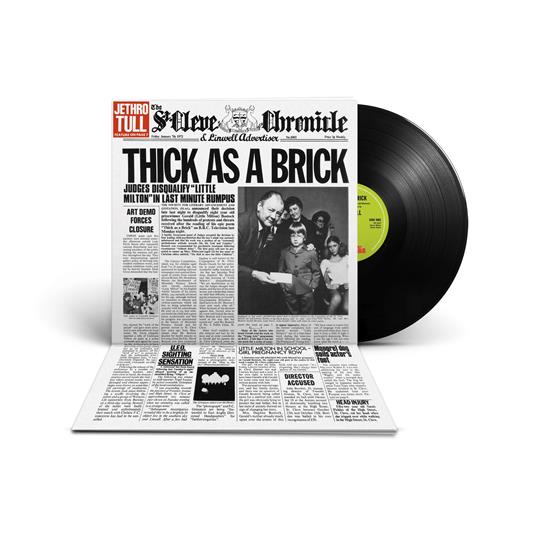
With musical nods to the original and a few other classic Tull riffs, Thick as a Brick returns to the fictional “star” of Thick as a Brick, Gerald Bostock, a precocious schoolboy whose “inappropriate” poetry was banned from a local contest, but later put to music by Jethro Tull, forming the epic title cut that spanned both sides of its original vinyl pressing.