"It's Thursday night, it's seven o'clock, it's Top Of The Pops!" To pop fans of a certain age, that phrase is dopamine rush. It means homework can be forgotten, the weekend is tantalisingly close, and pop music is about to happen in our drab 1980s living room. ( Excerpt from BBC)
But TOTP, as no-one ever called it outside of the print media, wasn't the BBC's only dalliance with the charts.
In fact, more than 70 different pop and rock shows have elbowed their way into the schedules since the BBC's inception 100 years ago.
That changed in 1952, with the debut of The Hit Parade, described by the Radio Times as "the most ambitious attempt yet made to present popular music on the screen in a directly visual way". Based on a US format, it featured about eight songs per half-hour episode, played by an in-house band instead of the original recording artists.
It set a template for shows like 1955's Off The Record, where Buddy Holly made his only UK TV appearance; and 1959's Drumbeat,
In doing so, it gave equal weight to global pop stars, ground-breaking new artists, anodyne family favourites and cheesy novelty nonsense.
A typical episode from 1978 saw punk upstarts The Boomtown Rats sharing airtime with Father Abraham and the Smurfs. Tonal consistency was neither offered nor desired.
But it was The Six-Five Special (1957-58) that marked the BBC's first real attempt to bring rock and roll to the small screen.
It's biggest innovation was allowing the audience to roam the studio floor, instead of sitting attentively in tiered seating, giving the show the kinetic energy of a concert.
Six-Five Special fell apart when the BBC insisted on adding educational segments, Replacements included 1958's Dig This!, 1963's The 625 Show (where the Beatles made their TV debut)
Top Of The Pops finally debuted on New Year's Day 1964, broadcast from a converted church in Manchester.
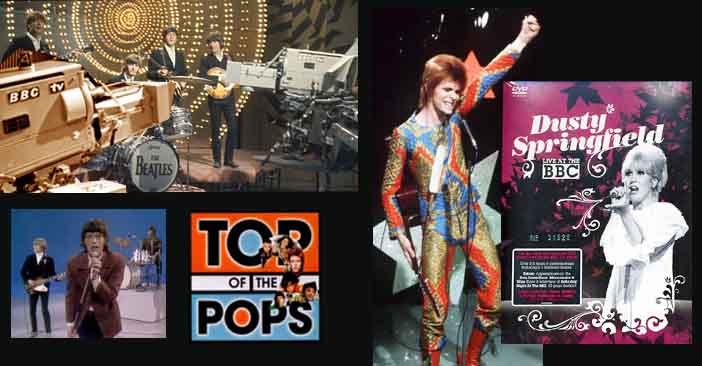
Dusty Springfield was the first ever artist to perform, playing I Only Want To Be With You, followed by the Rolling Stones' rambunctious I Wanna Be Your Man.
The Beatles' I Wanna Hold Your Hand was that week's number one, but the band weren't available to perform, so producer Johnnie Stewart put together a montage of archive footage, newsreels and still images to accompany the song.

Memorable moments include Neneh Cherry performing Buffalo Stance while seven months pregnant; Nirvana sabotaging their performance of Smells Like Teen Spirit; and David Bowie suggestively draping his arm around Mick Ronson during Starman - a watershed moment in pop that introduced a generation to androgyny.
The show ended in 2006 after falling viewing figures prompted a move to BBC Two and, ultimately, complete cancellation. The final number one on the final programme was Shakira's Hips Don't Lie.
But the Christmas special has somehow survived, and archive editions are repeated on BBC Four. However, the show's long association with Jimmy Savile means that many episodes are now unbroadcastable.
To read the full article click BBC