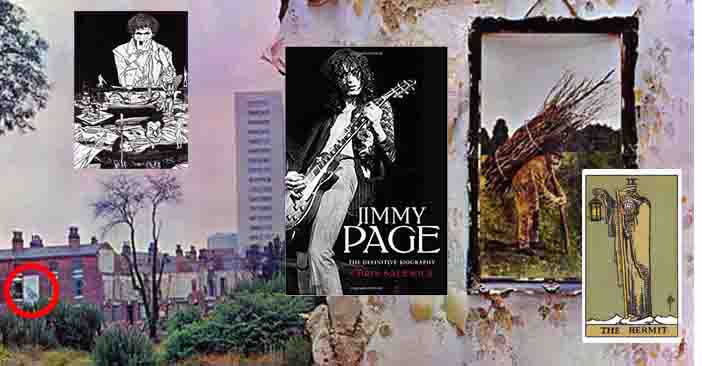
In this extract, Salewicz delves into the myths and legends surrounding the cover art of Led Zeppelin's classic fourth album. This is an excerpt from biography according with Loudersound, to read full click here
Visiting a second-hand shop in Reading, on the way to Headley Grange with Jimmy Page, Robert Plant unearthed a nineteenth-century painting of a rustic character bent low by the burden he carried on his back. This figure, Jimmy would immediately have noted, bore a distinct resemblance to ‘Old George’ Pickingill, who it was believed had first instructed Aleister Crowley in the occult arts.

Whatever its provenance, this was the central image that featured on the front sleeve of Led Zeppelin’s fourth album, affixed to a decaying house wall and overlooked by a Birmingham tower block; almost unnoticed is a poster for Oxfam that reads: ‘Someone dies from hunger everyday.’ Were Led Zeppelin – or more likely Jimmy Page, who was heavily involved with the design of each LP sleeve – professing to be carrying the weight of the eco world on their back? That seemed the most clear reading, confirmed by the guitarist in an interview with Dave Schulps of Trouser Press in 1977: ‘It represented the change in the balance which was going on. There was the old countryman and the blocks of flats being knocked down. It was just a way of saying that we should look after the earth, not rape and pillage it.’
Each member of Led Zeppelin was represented on the sleeve by a sigil, a rune-like symbol, a clear reflection of Page’s occult interests, and also of Robert Plant, even if the latter’s were less obsessive: the singer’s fondness for the Viking oracle method of runes had been solidified on the group’s trip to Iceland.
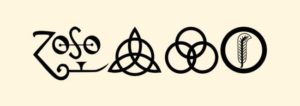
These were not archetypal symbols. But devised by each individual in the band. Both John Paul Jones and John Bonham took their sigils from Rudoph Koch’s The Book of Signs. Jones’s image was appropriately of an individual who possessed both confidence and competence. Bonham’s three interlocking rings represented the man, woman and child – of his marriage, presumably; twisted upside down, much to the delight of the rest of the band, Bonham’s image became the logo of Ballantine beer, his Midlands local brew. Robert Plant devised his own symbolic image, a feather within a circle, an icon that spoke very much of Native Americans but which the singer claimed was sourced from the ancient Mu civilisation.
The occult elements of the sleeve were only followed through on the central gatefold image. A painting that was a re-working of the Hermit, the ninth card of the major arcana in the Rider Waite tarot pack, which represents Prudence. The staff the Hermit bears is a symbol of his authority.
There is no record whatsoever of any such person, and there were those who believed the real painter was none other than Jimmy Page himself.
All the same, there was something very appealing and romantic about the notion of Jimmy Page as a rock ’n’ roll recluse, dabbling with potions and spells in his high tower.