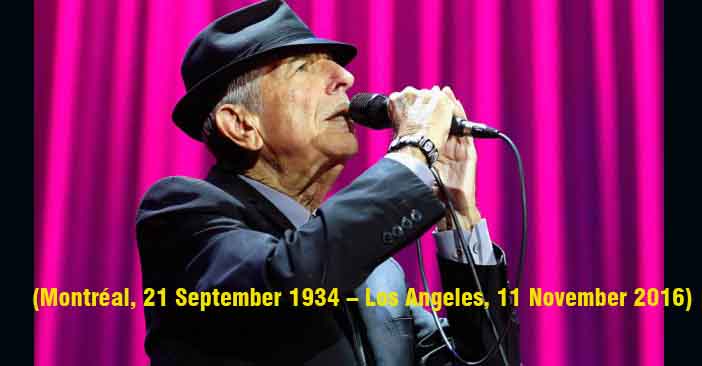
"It is with profound sorrow we report that legendary poet, songwriter and artist, Leonard Cohen has passed away," the statement read. "We have lost one of music's most revered and prolific visionaries. A memorial will take place in Los Angeles at a later date. The family requests privacy during their time of grief." A cause of death and exact date of death was not given. Leonard Norman Cohen Montréal, 21 settembre 1934 – Los Angeles, 7 novembre 2016)
Well Marianne, it’s come to this time when we are really so old and our bodies are falling apart and I think I will follow you very soon.
Less than a month ago, Leonard Cohen revealed in an interview with The New Yorker that he was ready to die.
His dry, monotone voice, which over the years deepened to a cigarette-charred whisper, contributed to Cohen’s popular image as a depressed — and depressing — artist. He teasingly alluded to that stereotype in one of his songs, referring to “the patron saint of envy and the grocer of despair.”
Cohen’s last LP, October’s “You Want It Darker,” reflected a deep awareness of his mortality.
Discussing his archive of unfinished songs during an in-depth interview, Cohen said: “I don’t think I’ll be able to finish those songs. Maybe, who knows? And maybe I’ll get a second wind, I don’t know. But I don’t dare attach myself to a spiritual strategy. I don’t dare do that.”
“I’ve got some work to do,” 82-year-old Cohen continued. “Take care of business. I am ready to die. I hope it’s not too uncomfortable. That’s about it for me.”
He later clarified the comments saying “I’ve always been into self-dramatisation. I intend to live forever.”
At the end of the playback, Cohen added: “Thanks for coming, friends. I really appreciate your standing up when I came into the room. I hope we can do this again. I intend to stick around until 120.”
Cohen released his 14th album, ‘You Want It Darker’, on October 21. It was the iconic artist’s third LP in six years, having not released a record for eight years prior to that.
"Unmatched in his creativity, insight and crippling candor, Leonard Cohen was a true visionary whose voice will be sorely missed," his manager Robert Kory wrote in a statement. "I was blessed to call him a friend, and for me to serve that bold artistic spirit firsthand, was a privilege and great gift. He leaves behind a legacy of work that will bring insight, inspiration and healing for generations to come."
Cohen was the dark eminence among a small pantheon of extremely influential singer-songwriters to emerge in the Sixties and early Seventies. Only Bob Dylan exerted a more profound influence upon his generation, and perhaps only Paul Simon and fellow Canadian Joni Mitchell equaled him as a song poet.
Cohen's haunting bass voice, nylon-stringed guitar patterns and Greek-chorus backing vocals shaped evocative songs that dealt with love and hate, sex and spirituality, war and peace, ecstasy and depression. He was also the rare artist of his generation to enjoy artistic success into his Eighties, releasing his final album, You Want It Darker, earlier this year.
"I never had the sense that there was an end," he said in 1992. "That there was a retirement or that there was a jackpot."
Leonard Norman Cohen was born on September 21st, 1934, in Westmount, Quebec. He learned guitar as a teenager and formed a folk group called the Buckskin Boys. Early exposure to Spanish writer Federico Garcia Lorca turned him toward poetry – while a flamenco guitar teacher convinced him to trade steel strings for nylon. After graduating from McGill University, Cohen moved to the Greek island of Hydra, where he purchased a house for $1,500 with the help of a modest trust fund established by his father, who died when Leonard was nine. While living on Hydra, Cohen published the poetry collection Flowers for Hitler (1964) and the novels The Favourite Game (1963) and Beautiful Losers (1966).