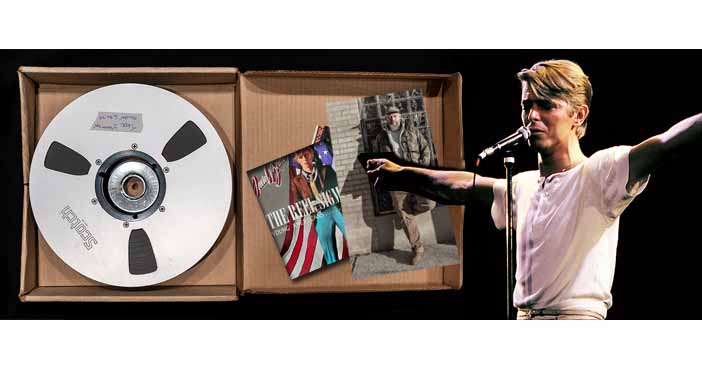
Moments from wiping it, Max Ochester discovered its secret – a never-before-heard David Bowie recording session... that he can’t play, can’t release and can’t sell
If anyone was likely to find a lost musical treasure in Philadelphia, it was Max Ochester.
This tape sat unwanted and forgotten for decades, before falling into the hands of a music obsessive
The discovery of David Bowie's lost tapes from the 'Young Americans' sessions at Sigma Sound Studios highlights the artist's meticulous approach to archiving his work, as he eventually reacquired these reels after they were found for sale online. Interestingly, Drexel University houses these tapes, which include unreleased tracks and informal studio banter, offering insights into Bowie's creative process during a pivotal time in his career.
Ochester has devoted his life to digging up rare vinyl and studio tapes, reissuing albums, recording forgotten artists and preserving the illustrious musical history of his home city.
In the early summer of 2022, he received a tip from a vinyl collector that a large collection of reel-to-reel studio tapes was for sale in a foreclosed house in the Philadelphia suburbs. When Ochester arrived there, a woman led him through the unfurnished house to a sunroom at the back, where the tapes were packed into 40 cardboard boxes. Ochester looked inside a box that was open. He saw tapes marked ‘The Intruders’, ‘Billy Paul’, ‘The Ebonys’ – legendary Philadelphia soul artists from the 1970s. He was excited and paid a few thousand dollars for the collection. It took three laborious trips with his car to move the boxes to his warehouse.
As he went through the haul, he found a single box of unmarked two-inch multitrack tapes. They were in box files that looked like the ones used at Sigma Sound Studios, where most of the 1970s Philadelphia soul hits were recorded. Apart from the word ‘scrap’ in pencil on one of the box files, nothing was written on the tapes, and Ochester assumed they were blank. They sat in the warehouse for two years, until June 2024, when Ochester went to Philadelphia’s Elm Street Studios to record one of his artists with producer/sound engineer Brendan McGeehan.
‘I took a couple of the tapes with me, because I was going to tape over them,’ Ochester says. Multitrack analogue tape is expensive and it’s commonplace for producers and engineers to reuse it, especially when they’re after an old-school sound, but when the tapes are decades old you have to bake them in an oven at low heat, or else they get gummy and start coming apart.
‘We baked them overnight and then Brendan threw them up on the reel-to-reel,’ says Ochester. ‘I just wanted to check there was nothing on the tapes before I erased them.’
The first tape had some funky disco jams. Ochester wasn’t much impressed. On the second tape, he and McGeehan heard a band playing an up-tempo R&B groove with a catchy little guitar riff. It was reminiscent of the riff on David Bowie’s song Fame. When the vocals came in, they recognised Luther Vandross as the singer and the song as a cover of Foot Stompin’ by The Flares.
Then the band started playing Can You Hear Me from David Bowie’s Young Americans album with Vandross singing the lead vocal. ‘That’s when I was just like, holy f—k, what do I have?’ says Ochester. ‘Because I knew it was a Bowie song. And I knew that Luther sang on Young Americans.’
The next song was a fast, romping version of the song Young Americans with no vocals and the distinctive sound of Bowie’s saxophone player David Sanborn wailing.
DISCLAIMER: the images used by Videomuzic are for the purpose of criticism and exercise of the right to report news, in low quality, in compliance with the provisions of the law on copyright, used exclusively for the information content.
DISCLAIMER: Videomuzic usa le immagini per finalità di critica ed esercizio del diritto di cronaca in modalità degradata conforme alle prescrizioni della legge sul diritto d'autore utilizzate ad esclusivo corredo dei contenuti informativi.