Read More: How Phil Spector Turned the Beatles' ‘Get Back’ Into ‘Let It Be’ | https://ultimateclassicrock.com/phil-spector-let-it-be-beatles/?utm_source=tsmclip&utm_medium=referral
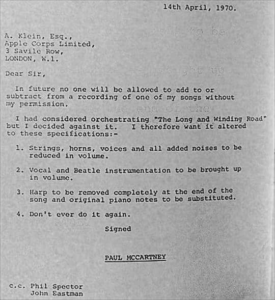
On 14 April, he sent a sharply worded letter to Apple Records business manager Allen Klein, demanding that the inclusion of the harp be eliminated and that the other added instrumentation and voices be reduced. McCartney concluded the letter with the words: “Don’t ever do it again.” These requests went unheeded, and the Spector version was included on the album with his overdubbed orchestration still in place.
“The Long and Winding Road.” It would become the final No. 1 hit by The Beatles, and Paul had good reason to hate the released version.
While the released version of the song was very successful, the post-production modifications by producer Phil Spector angered McCartney to the point that when he made his case in court for breaking up the Beatles as a legal entity, he cited the treatment of “The Long and Winding Road” as one of six reasons for doing so. New versions of the song with simpler instrumentation were subsequently released by both the Beatles and McCartney.
Harrison had become fed up with Lennon’s creative and communicative disengagement from the band and the two had a heated row during the day’s lunch break.
According to journalist Michael Housego of The Daily Sketch, this descended into violence with Harrison and Lennon allegedly throwing punches at each other. Harrison denied this in a 16 January interview for the Daily Express, saying: “There was no punch-up. We just fell out.” After lunch, Harrison announced that he was “leaving the band now” and told the others “see you round the clubs“. He promptly drove to his Esher home, Kinfauns, where he documented his frustrations with the group in a new composition, “Wah-Wah“. (thePaulMcCartneyProject.com)
McCartney: "I just sat down at my piano in Scotland, started playing and came up with that song, imagining it was going to be done by someone like Ray Charles. I have always found inspiration in the calm beauty of Scotland and again it proved the place where I found inspiration.
Beatles’ Let It Be Movie is to be re-edited into a new film
McCartney originally wrote the song at his farm in Scotland, and was inspired by the growing tension among the Beatles. McCartney said later “I just sat down at my piano in Scotland, started playing and came up with that song, imagining it was going to be done by someone like Ray Charles. I have always found inspiration in the calm beauty of Scotland and again it proved the place where I found inspiration.”
Paul McCartney offered this song to Tom Jones in 1968 on the condition it be his next single. He had "Without Love (There is Nothing)" set for release so he turned down the offer, something he would later regret. Speaking with Media Wales in 2012, Jones explained: "I saw him (McCartney) in a club called Scotts Of St. James on Jermyn Street in London. I said to him When are you going to write me a song then Paul? He said, aye I will then. Then not long after he sent a song around to my house, which was 'The Long And Winding Road,' but the condition was that I could do it but it had to be my next single.
Despite Paul’s protests, neither Klein nor The Beatles asked Spector for a do-over. In fact, they released the album with Spector’s overdubs the following month. Considering Paul had refused to delay the release of his record, he was hardly playing fair these days. No one had budged on anything.“The Long and Winding Road” hit No. 1 on the Billboard Hot 100 in the second week of June. More than 1 million copies sold in the first week of the single’s release.