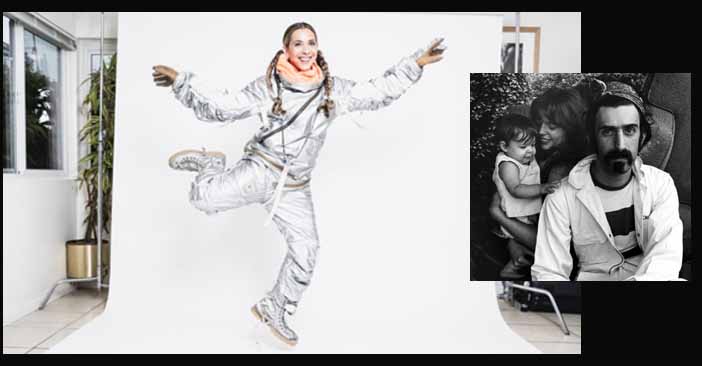
Moon Unit Zappa’s extraordinary family memoir. This is a book that frequently takes the breath from the lungs, and leaves the reader with the conviction that Zappa’s complicated clan must surely have been among America’s most dysfunctional.
Even those of us who know precious little about Frank Zappa seem somehow to know the basics: avant-garde 60s/70s rock star, routinely hailed a visionary and a genius; hair, nose, moustache. In Earth to Moon, real-life Zappa is a spectral figure whose attention span stretches only to his own proclivities, while his wife, Gail, is required to deal with everything else.
Together, Zappa and Gail would have four children: Moon Unit, Dweezil, Ahmet and Diva. Their oldest was given the middle name of Unit because Zappa believed that her arrival would bond them all for ever. Not so. Zappa was a rock star, after all, and had a reputation to perpetuate. There was art to create, and many women to sleep with. Briefly, there was one who lived within the family home, in the basement.
Moon realised quickly that hers was an atypical upbringing that she could only connect with at one remove, and sardonically. “Growing up, I was just like you,” she writes. “I had a rock star for a dad, two invisible camels for playmates, and daydreamed about my future following in Frank’s footsteps by helping people and making them laugh, only I’d be dressed like a nun.”
As creativity chafed against domesticity, her father, “a pagan absurdist”, was mostly absent. Those times he was at home, Moon did whatever she could to earn his attention.
When he laughed at her mimicry of 1980s California teen speak, he got her into the studio to record Valley Girl, a novelty song that surprised him by becoming, in 1982, his only global hit, and by making his daughter, aged 14, a star. This rankled. From here, she became an actor, mixing with Molly Ringwald and Tom Cruise, but rarely felt comfortable in her skin.
“Everyone says I look just like Dad. My dad is always saying he’s ugly. I guess that means I am ugly, too.” She bailed out of acting and into ashrams instead, returning home “wearing a Bindi, smiling vacantly and smelling of wet hairy armpit”.