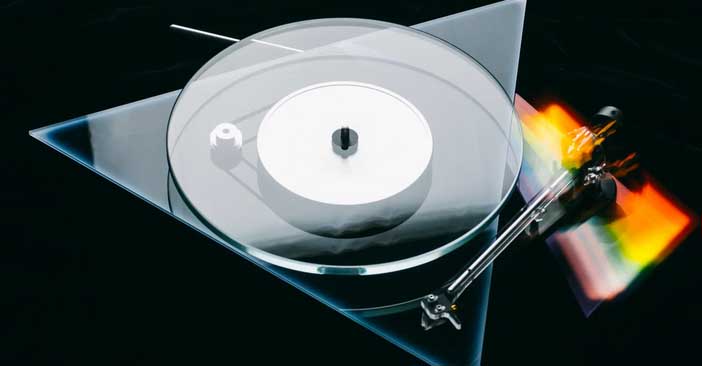
For those who remember the release of The Dark Side of the Moon fifty years ago, it was a turning point in the history of music. The album achieved remarkable global success, known not only for its music but also for its famous cover featuring a prism that elegantly splits white light into a spectrum of colors.
The turntable includes an LED-backlit rainbow directly referencing Storm Thorgerson’s album sleeve and George Hardie’s prism image. The design details, such as the triangular case and the extended on/off lever, echo elements from the original illustration. The turntable offers flexibility, allowing users to play records at both 33 and 45 rpm, maintaining stability due to its substantial 6kg weight. price: $1,999 limited edition.
More info: project-audio.com and henleyaudio.co.uk
Tech Specs:

Roger Waters: 'I’ve re-recorded The Dark Side of the Moon Beacause It’s my project’.
 With this nice statement the feud between the two could reach unexpected heights. ‘Wish you weren’t here' could be the best title for the next episode of the series. You can read Waters interview about Dark Side HERE
The new album includes narration by Waters, who speaks over many instrumental parts of the record.
Waters acknowledged a potential issue with the release, stating: “I’m no copyright expert, but might there be some obstacles to that? I have no idea.”
However, David Gilmour and Nick Mason opposed the claims, stating that Pink Floyd would not fold and that Waters couldn’t declare it dead while the group were still trying to make new music. Waters eventually came to an agreement with his former bandmates, one which saw him resign after careful legal considerations in 1987. However, he did note that the resignation was entirely forced by commercial restraints: “If I hadn’t, the financial repercussions would have wiped me out completely”.
Speaking to the BBC in 2013, Waters admitted that attempting to dissolve the band was not the right way to go: “I was wrong! Of course I was,” he said before adding: “Who cares? It’s one of the few times that the legal profession has taught me something.”
Detailing further, Waters added: “Because when I went to these chaps and said, ‘Listen we’re broke, this isn’t Pink Floyd anymore,’ they went, ‘What do you mean? That’s irrelevant, it is a label, and it has commercial value. You can’t say it’s going to cease to exist; you obviously don’t understand English jurisprudence.'”
Despite the unlikely reunion in 2005 for a performance at a charity benefit Live 8, a show in which the band managed to put their differences aside for a cause much more significant than their own, the Waters-Gilmour days are long gone, and the chances of another Pink Floyd show is now seemingly impossible. However, there remains a lingering belief that all hope may not be lost; after all, in 2008, the duo still had differences, but they “agreed to roll over for one night only” to get through the show.