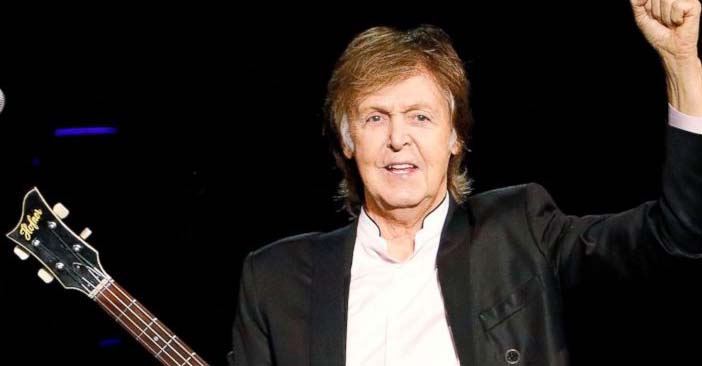
At 75, he plays his Beatles’ hits joyfully and answers questions about John, Yoko, Linda and “Sgt. Pepper” without offense at the implication that his life peaked before the moon landing. His current “One on One” tour stops in Sioux Falls, S.D., Hershey, Pa., and quite possibly your living room. Credits New York Times
“Paul McCartney” opens with Norman’s confession that, in hindsight, the offending passages in “Shout!” were fueled by a lifelong case of Paul envy: “All those years I’d spent wishing to be him had left me feeling in some obscure way that I needed to get my own back.” This is weird territory. It gets weirder as Norman, also 73, details the very slow, very British détente that led to McCartney’s tacit approval of the current book. The prologue is just a few cliché-clogged pages, but the messiness is tense and exciting. It teases a biography prepared to reckon with the lifetime of co-dependence between a thin-skinned icon and his covetous baby boomer fans.
The book that follows is vastly more conventional. “Paul McCartney” is an 853-page cinder block of facts in which we learn that young Paul enjoyed condensed milk and every kind of meat except tongue. Early letters and school assignments are reprinted and mined for future irony. Cats are named. Later, there are lengthy sections about McCartney’s sex life and drug preferences — but then, there are lengthy sections about everything. Real estate transactions, management squabbles, vegetarianism and seemingly every Wings rehearsal. Even Mum and Dad’s daily inquiries about little Paul’s poops get a mention.
Norman’s comprehensiveness is a bore, but he’s a good interviewer, and the book is charming when he lets his Liverpool sources speak about the days before the Beatles were inevitable. Colin Hanton was the drummer for the Quarrymen, Lennon’s first band, when McCartney arrived in July 1957 to audition: “He gave a great performance — showing off, really, but not in a bigheaded way. . . . You could see John thinking, ‘Yes, you’ll do.’ ” Iris Caldwell tells Norman that long before Paul discovered pot, he would wind down from local gigs with a special ritual: “Paul used to like my mum to comb his legs. He’s quite hairy, and having his legs combed seemed to relax him. He’d say, ‘Oo, Vi, give me legs a comb.’ ”
The descriptions of McCartney’s love life aren’t much better (“His sexual antenna as keen as his cultural one, he could always tell in advance which one it would be”), but at least bad writing about sex still has sex going for it. Other biographers have noted Paul’s infidelity during his engagement to the actress Jane Asher, but Norman uncovers a Bieber’s-worth of girlfriends, groupies and pregnancy scares that Brian Epstein, the Beatles’ manager, became expert at hiding. At one point three different girlfriends were living at McCartney’s bachelor mansion, until the arrival of Linda Eastman scattered the competition.
When the Beatles dissolve and Paul sets off on a less consequential trajectory through vegetarian cookery, horseback riding and classical composition, Norman continues to spit out facts without discernment. He’s just as interested in listing all the instruments McCartney played on his unmemorable 1993 solo album “Off the Ground” as in the details of the post-divorce P.R. strategy of Paul’s second wife, Heather Mills. McCartney is admirably generous in his later years, but Norman can’t bear to leave out a single act of kindness, including the time “he saw an elderly woman on the platform struggling with a heavy bag and insisted on carrying it for her.”
“Paul McCartney” is full of things that happened to Paul McCartney, and through absurd fame and a few tragedies he appears to be an unusually decent man with few regrets. But facts aren’t insight, and readers won’t emerge with any real idea what it was like to have lived one of modernity’s most amazing lives. At least in that sense Norman’s subject remains elusive.