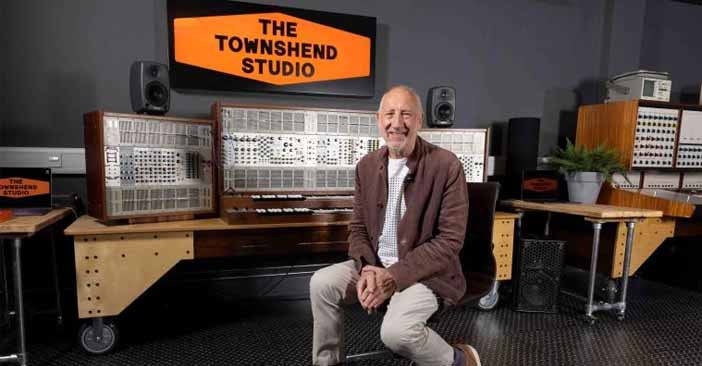
The Townshend Studio, which was unveiled on Thursday 10 October, is part of UWL’s London College of Music at the University’s Ealing campus. The new studio arose from Pete Townshend looking for a home for his synthesisers, leaving a legacy for the next generation and a catalyst for creativity. (uwl.ac.uk)
The collection includes some of the most influential instruments in the development of electronic music. It comprises 12 principal synthesisers including the ARP Model 2500 (1970), used on 'Quadrophenia', and the rare and sought-after Yamaha GX-1 (1975), one of only 10 made with a retail price of over 60,000 USD on release, plus many other instruments played by Townshend throughout his career.
"It’s my hope that the studio will be a creative space for learning, collaboration, experimentation and play, inspired by the musical and artistic legacy of Ealing, an area integral to the development of British music in the 1960s,” said Pete Townshend.

The programme encouraged students to re-think their relationship to their work, audiences and environment, with Ascott instructing students to “...stop thinking about artworks as objects, and start thinking about them as triggers for experiences.”
"I was at an art school where the course was dedicated to breaking the rules and I just drafted that into my work as a guitar player. I came up with target t-shirts, Union Jack jackets, the arrow over the ‘O’ in the name The Who... it taught me about presentation and the importance of the client, or in my case, the audience.”