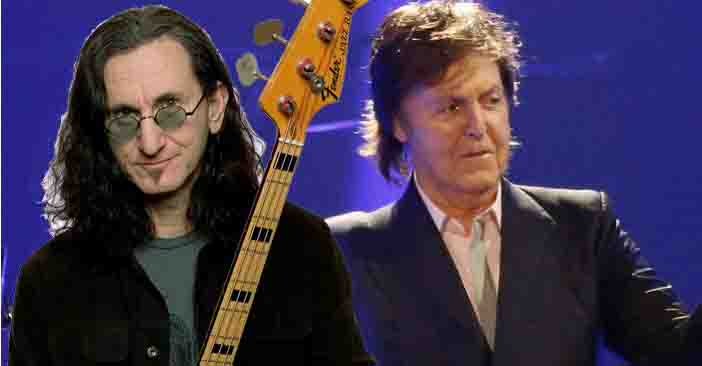
He also praised The Beatles’ legendary bassist Paul McCartney, and revealed why McCartney is so important for rock music. Here’s the statement:
“I think about McCartney on [The Beatles’ 1969 track] ‘Something,’ I think that was the first time I ever heard the bass as a lead instrument. Source metaldeathzone
That’s not uncommon in the early days of pop. There were a lot of so-called lead lines, but they’re played down with the dulcet tones, the lower tones, and so people don’t really appreciate that a lot of content as a lead instrument, but it really is doing that job.”
On why he started with bass guitar, he said:
“No one becomes a bass player willingly. You get voted to be the bass player when the bass player that was chosen originally quits. In my case, we were in a little basement band, only it wasn’t a basement band, it was an apartment-bedroom band.
And the guy that was supposed to play bass with us, his mother really didn’t like him associating with us, so he left. And then they all looked at me and said, ‘Okay, you’re going to be the bass player.’
I went to my mom and I begged her to lend me like $30 so I could buy a bass, and that’s how it all started.”
Watch the entire interview below. Click here to source of the statement.
Recently Sir Paul McCartney has approved a unique reworking of a Beatles classic which will be performed during the first Animal Requiem, a memorial concert celebrating the lives of deceased pets. 
Audience members are invited to bring a photograph, portraying a happy memory of their beloved pet to the concert, held at the St James’ Church, in Piccadilly,
London. They can pin their photo to a large board that will be placed in view, then light a candle in remembrance of their pet. Animal Requiem premiere This will be followed by a full orchestral and choir performance of the Animal Requiem, a work composed by Rachel Fuller, the singer-songwriter who is married to Pete Townshend of The Who.
Rachel Fuller and her husband Pete Townshend of The Who (Amy Sussman/Getty Images) Fuller, who admits that acquiring canines is something of an addiction, was inspired to create the work in response to the grief she felt after losing six dogs to old age over the space of five years.