Releases like ‘Space Oddity’ and Hunky Dory turned the tide heading into the 1970s, consolidated in 1972 by The Rise and Fall of Ziggy Stardust and the Spiders From Mars. Towards the end of the decade, Bowie released his lauded and experimental Berlin Trilogy before reuniting with his pop sensibilities.
In 2008, David Bowie created a compilation comprising 12 favourites from his own back catalogue. Initially, the CD was intended as a collection of personal favourites available exclusively with an edition of The Mail on Sunday. Due to popular demand, the newspaper quickly sold out, and the CD became a highly popular collector’s item. Virgin/EMI later reissued the CD along with a booklet containing Bowie’s comments on each track.
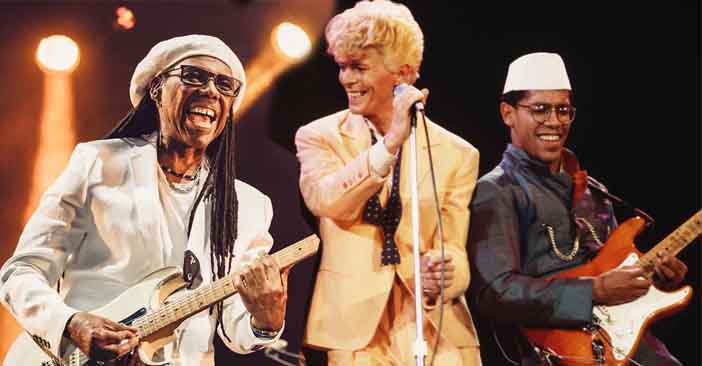
In an interview with The Recording Academy, Nile Rodgers (the album producer) says, “When David asked me to produce Let’s Dance, he and I had just met. We just bumped into each other at a club and started talking, and I was amazed at his knowledge of jazz artists and composers and arrangers. "
“He then called me and realised, okay, you’re the guy I want to produce my next album. I go to his house in Switzerland, and he comes into my bedroom and says, ‘Now darling, I think this is a hit.’ And he starts playing a song that sounds very much like a folk song, and that wasn’t what we agreed we were going to do, but he was really into it. He said, ‘I call it Let’s Dance.’
“I said, ‘Man, I come from dance music. Let me do an arrangement.’ And basically, I restructured the whole thing. I had never heard Let’s Dance until we went to the recording studio the following day and played it. Of course, as an arranger, you can hear it in your head sort of, but I write for an ensemble. When we did the demo, we didn’t have a keyboard player. It was just two guitars, very James Brown style.”
Discussing ‘Teenage Wildlife’ as a particular favourite of his pop-transition era, Bowie compared the song to ‘Modern Love’. He said: “So it’s late morning, and I’m thinking, ‘New song and a fresh approach. I know. I’m going to do a Ronnie Spector. Oh yes, I am. Ersatz just for one day.’ And I did, and here it is. Bless. I’m still very enamoured of this song and would give you two ‘Modern Love’s for it anytime.”
When Modern Love was released as a single, on 12 September 1983, the Let’s Dance album had already been out for five months, and Bowie was well into his worldwide Serious Moonlight Tour, a recording from which, taken from a 13 July performance at the Montreal Forum, provided the live performance of Modern Love issued as the single’s B-side.
Placed at the start of the album, the song kicked off a three-track run which also included China Girl and Let’s Dance, the trio making good on Bowie’s intentions to unleash his most pop-minded statement yet. “He wanted the whole thing to be great,” Nile Rodgers told Uncut magazine decades later. “And that’s why we had not only Let’s Dance, but also Modern Love, which was groundbreaking.”
“David might not want me to say this,” Nile Rodgers revealed, “but for the first few weeks, even he was surprised. He’s a big artist and a rock’n’roll demigod, but there was still a garage-band guy in there who couldn’t believe his record was selling. I’d be lying in bed, and the phone would ring: ‘Hello, Nile? This is David. Look what’s happening, did you see Billboard this week? Wow, unbelievable!’”