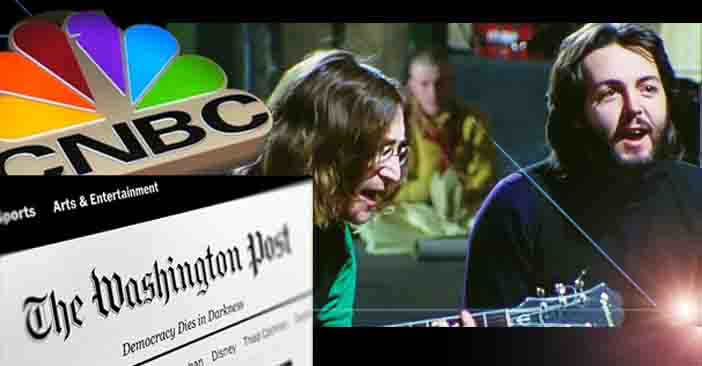
Part of the untold truth of the Beatles is the complicated situation surrounding the Fab Four's final bursts of creativity, including "Let It Be."
"Let It Be" leaves out so much of the story of the Beatles in 1969 that would see the band irrevocably falling apart. Here's everything the "Let It Be" documentary didn't explain about the last days of the Beatles. (Grunge)
1 The Impact and the importance of Billy Preston joining The Beatles
Billy Preston spent a lot of time working with the Rolling Stones after the Beatles, but he isn't even identified, singled out, or acknowledged in "Let It Be." . The Beatles knew the musician from its early days playing in Hamburg, Germany, and George Harrison brought him in during the sessions for what would become the "Let It Be" album to inject new energy into the band and flesh out its sound as it prepared to perform live.
The band was on its last legs, and Preston brought so much energy and newness into the band that they even considered adding him as a permanent member. Instead, he just played on "Get Back" and with the Beatles at its rooftop concert seen in "Let It Be."
2 The Beatles rehearsed a lot more songs than shown on screen
The songs that the Beatles rehearse inside, and then perform outside, would later populate the 1970 album "Let It Be." Later standouts from that record are all over the "Let It Be" documentary in various permutations, including "The Long and Winding Road," "Get Back," and "Across the Universe," as well as "Abbey Road" tracks like "Maxwell's Silver Hammer and "Octopus's Garden," "Something," "Mean Mr. Mustard," "Polythene Pam," "She Came in Through the Bathroom Window," and "Carry That Weight."
3 The rooftop concert was a lot longer
The concert takes up only about 20 minutes of screen time in "Let It Be," and the film presents six distinct songs: "Get Back," "Don't Let Me Down," "I've Got a Feeling," "One After 909," "Dig a Pony," and then another crack at "Get Back." The documentary leaves out a large portion of this important moment in Beatles history by way of excising several songs.
4 The rooftop concert almost didn't happen
Expectations scaled down over time to where a rooftop concert was suggested, of which the Beatles remained noncommittal and unmoved until the moment before they picked up their instruments before John Lennon gave it the go-ahead. Unable to come to a decision as a group, Lennon said, "'F*** it — let's go do it,'" Lindsay-Hogg recalled in "The Beatles: Get Back" book.
5 The Rehearsals were supposed to generate a live album
The documentary never makes it fully clear that the songs the Beatles rehearse are the ones they're virtually writing simultaneously. For example, Paul McCartney workshops "Get Back" in front of the cameras. Nor does "Let It Be" let on that the rooftop concert was an alternative to the initial, ambitious goal of the project. Before filming and recording began, the Beatles were supposed to perform in a large venue, such as the Sabratha Amphitheater in Libya.
6 Geroge left the band
One day, when the group took a lunch break, Harrison announced he was done, went home, and didn't come back.
The group, along with Yoko Ono, ultimately pleaded for Harrison to return, and after he took some time off with a trip to his hometown of Liverpool, he did rejoin the Beatles. However, it was with some caveats. The reason why the action in "Let It Be" switches abruptly from an eerily lit TV studio to a bright, white, well-appointed rehearsal space was at Harrison's insistence. He felt more comfortable rehearsing at Apple Corps than Twickenham Film Studios, and he wanted to focus on the album and move away from the concert angle, thus explaining the move.
7 The Yoko Ono Factor
One of the myths you can stop believing about the Beatles: that Yoko Ono actively tried to split up the group. By 1969, John Lennon had fallen in love with and become engaged to Ono, also becoming an acolyte of the experimental artist. What Yoko Ono's relationship with the Beatles was really like was more complicated than that. She was a big presence in Lennon's life during the filmed recording and rehearsal sessions that would become "Let It Be," and was apparently physically in the room at the time, too.