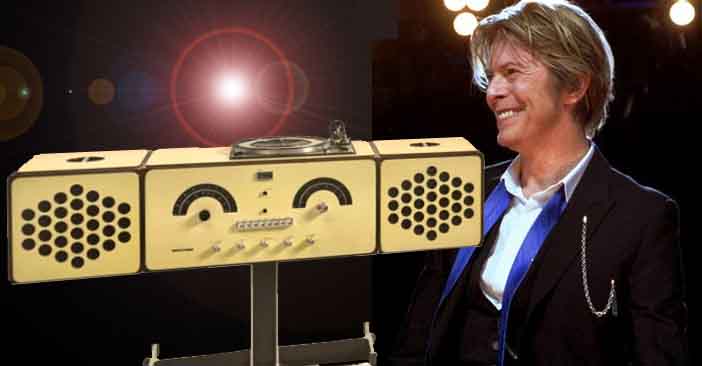
The Brionvega Radiofonografo Hi-Fi system first made jaws drop in 1965 and had a swathe of famous fans, including David Bowie. And now the stylish setup has returned as a strictly limited edition.
David Bowie's personal record player – a custom-made Brionvega turntable designed as a "musical pet" – has sold, on May 2020, at auction for £257,000. The Starman's pride and joy sold as part of a two-day auction at Sotheby's.
Designed by Achille and Pier Giacomo Castiglioni in Italy in 1966, the turntable was styled as the singer's "musical pet". It's made of plastic-laminated wood, painted aluminium and polycarbonate, and comes on castors.
Bowie said that the tube system gave his vinyl a wonderful warm sound.
The price is on application, but it's going to be expensive. The standard Radiofonografo has a price tag of €14,000 (£12,185 / $16,395 / AU$24,775) and previous special editions have cost anywhere up to €22,000 (about £19,150 / $25,760 / AU$39,935).
The best David Bowie songs to test your hi-fi system according to Whathifi.com
Close-mic’d acoustic guitar, front-line vocal that’s considerably closer-mic’d than that, and some oddly treated organ and bass form the basis of the deeply unsettling closing track from the 1971 album that almost, but not quite, brought Bowie to mainstream attention.
The 80s were not exactly kind to David Bowie – he spent too much time second-guessing himself and worrying about how best to repay the absolutely enormous advance paid to him by new record label EMI America, and consequently, inspiration was at a premium.
During the couple of years Bowie spent in Los Angeles he developed a) an epic cocaine habit, and b) a theory of ‘the squashed remains of ethnic music… written and sung by a white Limey’. Both in equal measure inform Stay, a sweeping, warped dancefloor-friendly powerhouse of heroic ambition performed by a team of crack musicians. Rhythmic expression and positivity are key here, so control and intensity of both the low frequencies and percussive sounds at the opposite end of the range must be keen.
By now, Bowie’s influence is such that any number of imitators are slapping on the make-up, demanding increasingly outlandish hairdos and adopting outrageous ‘gor blimey missus’ London inflections in their singing voices – but not one of them has a hint of his star-power, of course. It’s a state of affairs made only too plain by Fashion, an effortlessly classy slice of funk-rock punctuated by a Robert Fripp guitar line that sounds like animals fighting.