
While everyone in the band that recorded Station to Station had been using drugs, Slick said that he and Bowie were by far the worst. (Ultimateclassicrock)
“Well, how I was doing what I do on that record was no different than the way I did anything else, and my drinking and drug habits weren’t any different either, so I was operating on my normal paradigm, you know?” Slick shrugs. “David had gone levels into insanity, but the rhythm section – Carlos Alomar, George Murray, Dennis Davis – didn’t imbibe anything close to the silliness that David and I did. Had they been as fucked up as we were, that record would have sucked. But we spent a lot of time together, me and David, just doing my guitar overdubs and stuff, and we were able to work in that condition quite well. We were in our 20s. You can do serious damage to yourself in your 20s and still make records. I’d only been doing [drugs] for seven or eight years. You couldn’t do that amount of drugs for 25 years and think you’re going to make records. You’re not.” He laughs. “Unless you’re Keith Richards.”
As plans for the tour were coming together, Slick encountered problems with his contract that he was unable to resolve. He didn’t discover that management had been the reason until he rejoined Bowie in 1983. “He found out that they had not let me talk to him, and I found out he had had no idea what was going on,” the guitarist said. “It reminded me of the Elvis thing, man. The guy was so fucked up, and everybody around him was taking advantage of his money and keeping information from him that they didn’t want him to know.”
The last time the pair spoke was a few months before Bowie’s death from cancer in 2016, as Slick was preparing his own Station to Station tour. “I ran it past him, and he said: ‘Great idea, Slicky. Have fun.’” He reported that he hadn’t realized how ill his bandmate really was, although he’d noticed changes as they worked on 2013’s The Next Day. “[He] didn’t look so good, didn’t look himself, but he was prone to depression, and that’s what I thought it was,” Slick said. He recalled: “We were sitting in the control room of the studio, listening to ‘(You Will) Set the World on Fire,’ and David says: ‘Man, that track would be great live.’ I looked at him, but before I could even answer, he goes: ‘Don’t even think about it.’”
Hansa Studios: By The Wall 1976-90 sees filmmaker Mike Christie delving into the history of the venue and its cultural and artistic significance.
In the studio beside the wall, Bowie wrote his hit “Heroes“. He recorded numerous albums here, also together with his friend and colleague Iggy Pop. not far from the reconstructed Potsdamer Platz. The studio - which used to overlook the Wall -
The Hansa Tonstudio is a recording studio, since 1974 located in a former builders' guild hall on Köthener Straße No. 38 in the Kreuzberg district of Berlin, Germany. Famous for its Meistersaal recording hall, it used to be known as "
“Within its walls, David Bowie created his timeless 1977 albums Low and “Heroes” – records made in collaboration with Brian Eno. It was during this Hansa period that the phrase was coined, ‘There's Old Wave. There's New Wave. And there's David Bowie.’”
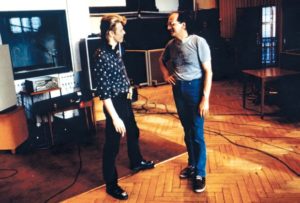
Other artists to record classic albums at Hansa include Marillion (Misplaced Childhood) Iggy Pop (Lust For Life) R.E.M. (Collapse Into Now) Depeche Mode (Black Celebration) U2 (Achtung Baby), Killing Joke (Night Time, Brighter Than A Thousand Suns) and Siouxsie & The Banshees (Tinderbox). source udiscovermusic.com
Depeche Mode "Construction Time Again" (1983), U2 "Achtung Baby" (1991), Nick Cave & The Bad Seeds, Marillion "Misplaced Childhood" (1984), Real Life "Send Me An Angel" (1982) and many other top acts produced their worldwide successes at Hansa Studios.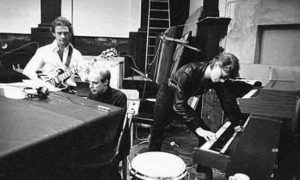
Up a sweeping wooden staircase on the first floor lies Studio 2, or ‘The Great Hall by the Wall’ as it was affectionately termed because of the building’s proximity to the Mauer.

The 650sqm room might look a bit sanitised – it’s now occasionally used as a conference room – but it is still as grand as at its birth as a chamber music hall in 1913, with 15m-high coffered ceilings and wooden patterned floorboards. Velvet curtains frame windows, and five-pendant chandeliers cast a regal glow.
It may be atypically large for a studio, but still today, the sound of a clap reverberating through the cavernous space brings happy tears to a sound engineer.